

A Group 31 battery is a popular heavy-duty battery size used in commercial trucks, buses, boats, RVs, and other equipment. Its larger case provides space for substantial starting power and battery capacity. However, before choosing one, you should understand its exact dimensions and check whether it fits your battery compartment.
The standard BCI Group 31 battery measures approximately 13 inches long, 6.81 inches wide, and 9.44 inches high. In metric measurements, that equals 330 × 173 × 240 millimeters. These are the maximum overall dimensions listed for the standard group size. Individual batteries may measure slightly differently depending on the manufacturer and terminal design.
This guide explains Group 31 battery measurements, conversions, common applications, battery types, and important fitment details. It also compares Group 31 with other popular battery sizes to help you understand its overall size.
Standard Group 31 Battery Dimensions
Group 31 batteries follow a physical size classification established by Battery Council International (BCI). The classification helps identify the battery’s case dimensions and terminal arrangement.
Here are the standard maximum overall measurements:
| Dimension | Inches | Millimeters | Centimeters |
|---|---|---|---|
| Length | 13 inches | 330 mm | 33 cm |
| Width | 6.81 inches | 173 mm | 17.3 cm |
| Height | 9.44 inches | 240 mm | 24 cm |
The length describes the longest side of the battery case. The width measures the distance across its shorter side. Meanwhile, the height measures the vertical distance, including the overall terminal height specified by the standard.
These measurements provide a useful starting point when checking a battery tray. However, do not assume every Group 31 model has identical dimensions. Always check the manufacturer’s specification sheet before purchasing a replacement.
How Big Is a Group 31 Battery?

A Group 31 battery is relatively large compared with many standard passenger-car batteries. Its 13-inch length makes it suitable for battery compartments designed for heavy-duty applications.
To picture its size, imagine a rectangular box that measures about 33 centimeters long and 17.3 centimeters wide. Its height reaches approximately 24 centimeters.
The battery also needs enough room for its cables, terminals, mounting hardware, and any required ventilation. Therefore, the available space should be slightly larger than the battery itself.
For example, a battery tray measuring exactly 13 inches long may not provide enough room for easy installation. A small amount of extra clearance makes it easier to position and secure the battery.
Group 31 Battery Dimensions in Different Units
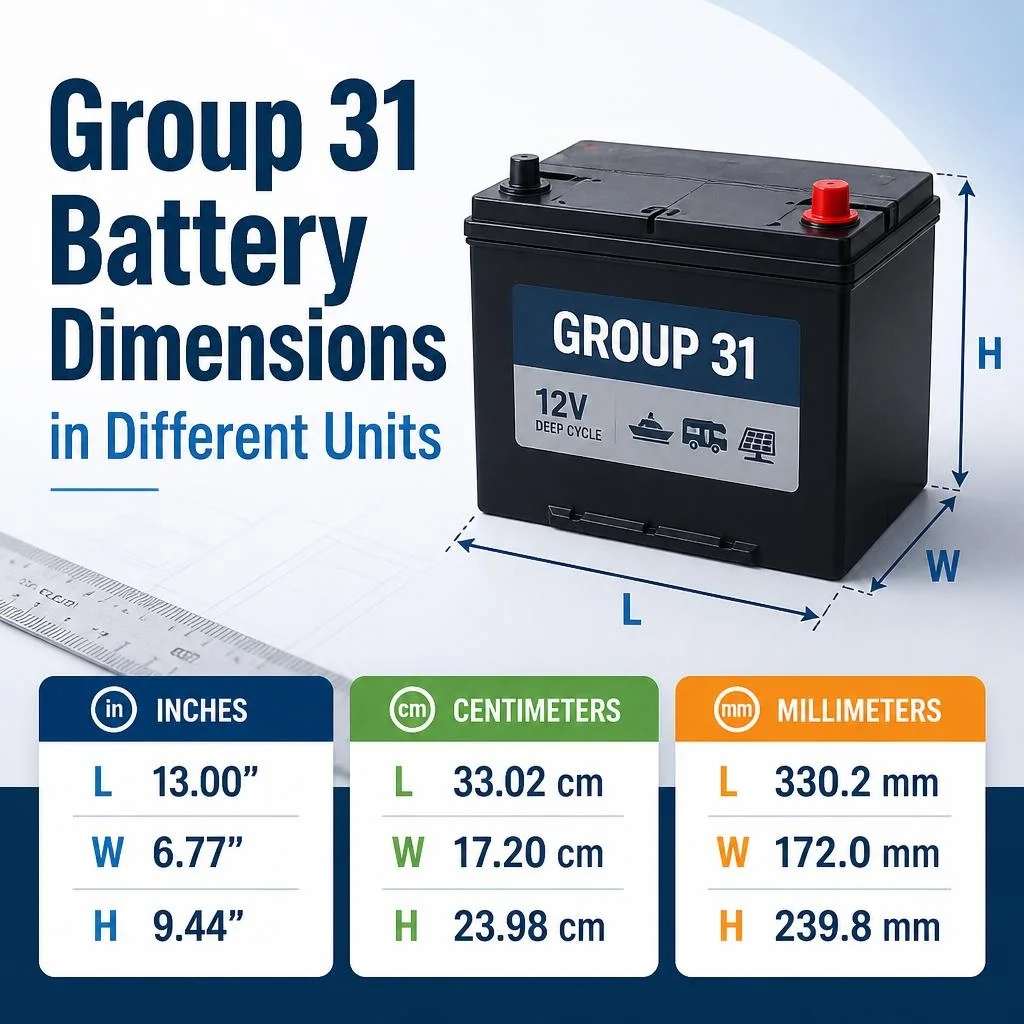
Battery manufacturers may list dimensions in inches or millimeters. Knowing both systems makes it easier to compare specifications.
Inches
The standard maximum dimensions are:
- Length: 13 inches
- Width: 6.81 inches
- Height: 9.44 inches
These figures are useful when measuring a battery compartment with a standard US measuring tape.
Centimeters
To convert inches into centimeters, multiply each measurement by 2.54.
The approximate results are:
- Length: 33 cm
- Width: 17.3 cm
- Height: 24 cm
This conversion helps when comparing the battery with equipment that uses metric measurements.
Millimeters
Millimeters provide a more detailed measurement for installation and clearance checks.
The standard dimensions are approximately:
- Length: 330 mm
- Width: 173 mm
- Height: 240 mm
If your battery tray has tight dimensions, millimeters can help you identify small differences between the available space and the battery case.
Group 31 Battery Size Compared With Other Battery Groups
Group 31 is larger than several common automotive battery groups. Comparing these sizes can help you understand why a battery designed for one tray may not fit another.
| BCI Group | Length | Width | Height |
|---|---|---|---|
| Group 24 | 10.25 in | 6.81 in | 8.88 in |
| Group 27 | 12.06 in | 6.81 in | 8.88 in |
| Group 31 | 13 in | 6.81 in | 9.44 in |
| Group 34 | 10.25 in | 6.81 in | 7.88 in |
| Group 35 | 9.06 in | 6.88 in | 8.88 in |
Group 31 shares a similar width with several other battery groups. However, it is longer and taller than Groups 24 and 27.
That difference matters when replacing an existing battery. Even if two batteries have similar widths, their lengths, heights, terminal positions, and mounting systems may prevent them from being interchangeable.
Group 31 vs. Group 24 Battery Dimensions

A Group 24 battery measures approximately 10.25 × 6.81 × 8.88 inches. A Group 31 battery measures approximately 13 × 6.81 × 9.44 inches.
The Group 31 battery is therefore about 2.75 inches longer and 0.56 inches taller. Both sizes have a similar width.
This difference means a Group 31 battery usually needs a longer battery tray. It may also require a different hold-down system.
Group 31 vs. Group 27 Battery Dimensions

Group 27 batteries measure approximately 12.06 × 6.81 × 8.88 inches.
Compared with Group 27, Group 31 is about 0.94 inches longer and 0.56 inches taller. Their widths are approximately the same.
Although these two sizes look similar, they do not automatically fit the same battery compartment. Check the manufacturer’s measurements and mounting requirements before changing sizes.
What Is a Group 31 Battery Used For?

Group 31 batteries commonly serve vehicles and equipment that need reliable starting power or substantial electrical capacity.
Their larger case makes them useful in several applications.
Commercial Trucks

Heavy-duty trucks often need batteries that can handle demanding starting conditions and support electrical equipment. Group 31 batteries appear in many commercial vehicle applications.
Some trucks use multiple batteries to meet their electrical requirements. The correct number and type depend on the vehicle’s design.
Buses

Buses may use Group 31 batteries for engine starting and electrical support. Their battery systems can vary according to engine size, electrical accessories, and manufacturer requirements.
Boats and Marine Equipment

Group 31 marine batteries are available for certain starting and deep-cycle applications. They may support engine starting, onboard electronics, lighting, and other electrical equipment.
However, marine batteries need suitable terminal arrangements and mounting protection. Always choose a battery designed for the intended marine application.
RVs and Campers

Some recreational vehicles use Group 31 batteries to support electrical systems. Depending on the battery type, these systems may power lights, fans, refrigerators, and other accessories.
A deep-cycle battery may suit repeated power use better than a standard starting battery. Check the RV manufacturer’s requirements before selecting one.
Construction and Industrial Equipment

Construction machinery and industrial equipment may use Group 31 batteries for engine starting and electrical support.
The correct battery depends on the machine’s electrical system, operating conditions, and required performance ratings.
Group 31 Battery Types
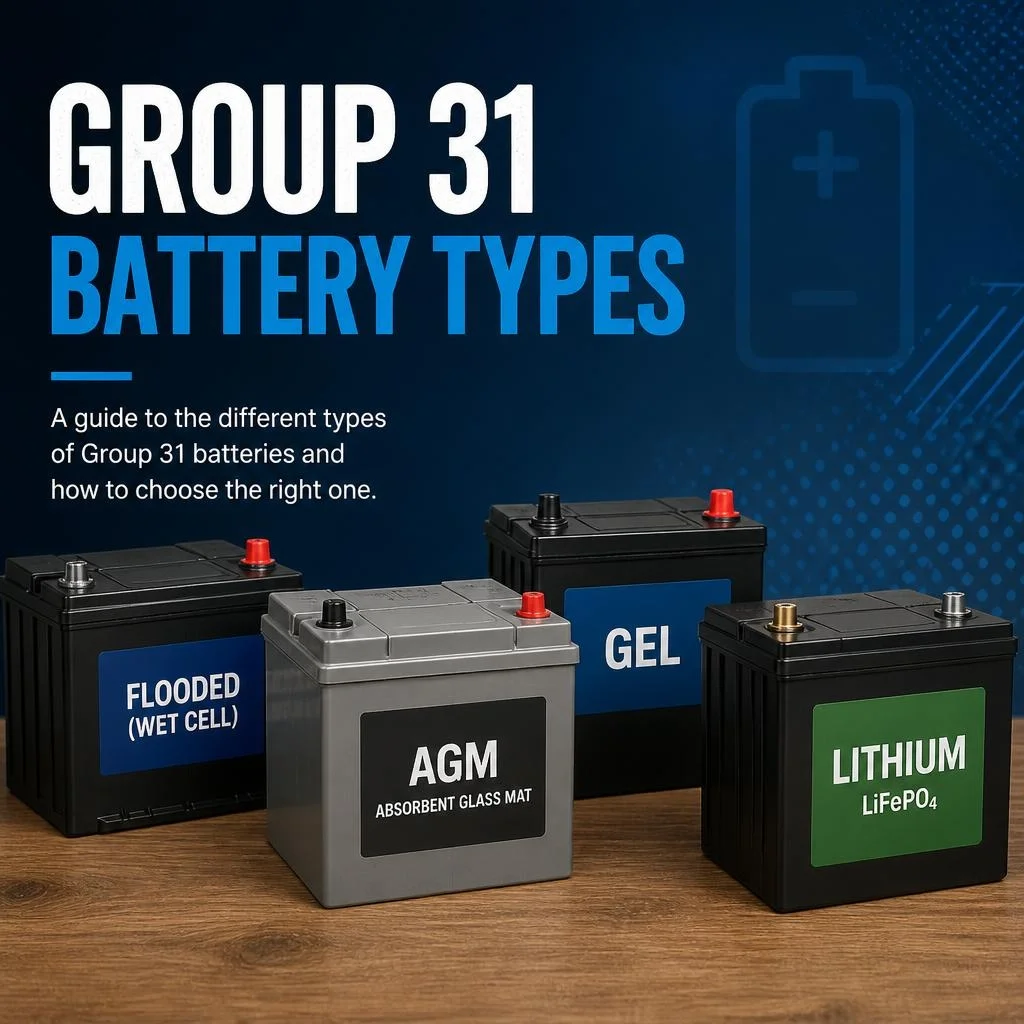
The Group 31 classification describes the battery’s physical size. It does not identify one specific battery technology.
You can find Group 31 batteries in several designs.
Flooded Lead-Acid Batteries
Flooded lead-acid batteries use liquid electrolyte inside the case. They are widely used in automotive and commercial applications.
Some models require periodic maintenance, including electrolyte-level checks. Maintenance-free versions are also available.
AGM Batteries
AGM stands for Absorbent Glass Mat. These batteries hold electrolyte in a special glass-fiber material between their plates.
AGM batteries are sealed and offer several benefits for demanding applications. They can also support vehicles and equipment with higher electrical demands.
However, an AGM battery may require a compatible charging system. Check the equipment manufacturer’s recommendations before switching battery technology.
Lithium Batteries
Some Group 31 batteries use lithium iron phosphate (LiFePO4) technology. These batteries can offer lower weight and useful deep-cycle performance.
Their internal design differs from lead-acid batteries. Therefore, you should check voltage compatibility, charging requirements, battery management features, and temperature limits before installation.
A lithium battery that shares the Group 31 case size is not automatically suitable for every vehicle or charging system.
Group 31 Battery Weight and Capacity

Battery weight and capacity vary by manufacturer and technology. The group number identifies the physical size, not a fixed amp-hour rating or exact weight.
Many traditional Group 31 lead-acid batteries weigh around 50 to 75 pounds. Some models fall outside this range, so always check the product specifications.
Capacity also varies. Some Group 31 batteries offer around 100 amp-hours, while others provide different ratings.
When comparing batteries, review these specifications:
- Amp-hours (Ah): Indicates the battery’s rated electrical capacity under a stated test condition.
- Cold Cranking Amps (CCA): Measures starting performance at low temperatures.
- Marine Cranking Amps (MCA): Measures cranking performance under a warmer test condition.
- Reserve Capacity (RC): Indicates how long a battery can supply a specified current under a defined test.
- Voltage: Confirms the battery’s nominal electrical voltage.
Do not select a battery based on its size alone. Its electrical ratings must also meet the equipment’s requirements.
Group 31A and Group 31T Differences

You may see Group 31 batteries identified as 31A or 31T. These labels relate to terminal configurations.
Group 31A generally uses Type A top-post terminals. Group 31T uses a different terminal arrangement, commonly associated with threaded stud connections.
This distinction matters because battery cables must connect correctly and securely. A battery may fit inside the tray but still fail to work as a direct replacement if its terminals do not match the original setup.
Before purchasing, check:
- Terminal type
- Positive and negative terminal positions
- Cable reach
- Cable connection style
- Hold-down arrangement
Never assume that every Group 31 battery uses the same terminal layout.
How to Measure a Battery Tray for Group 31
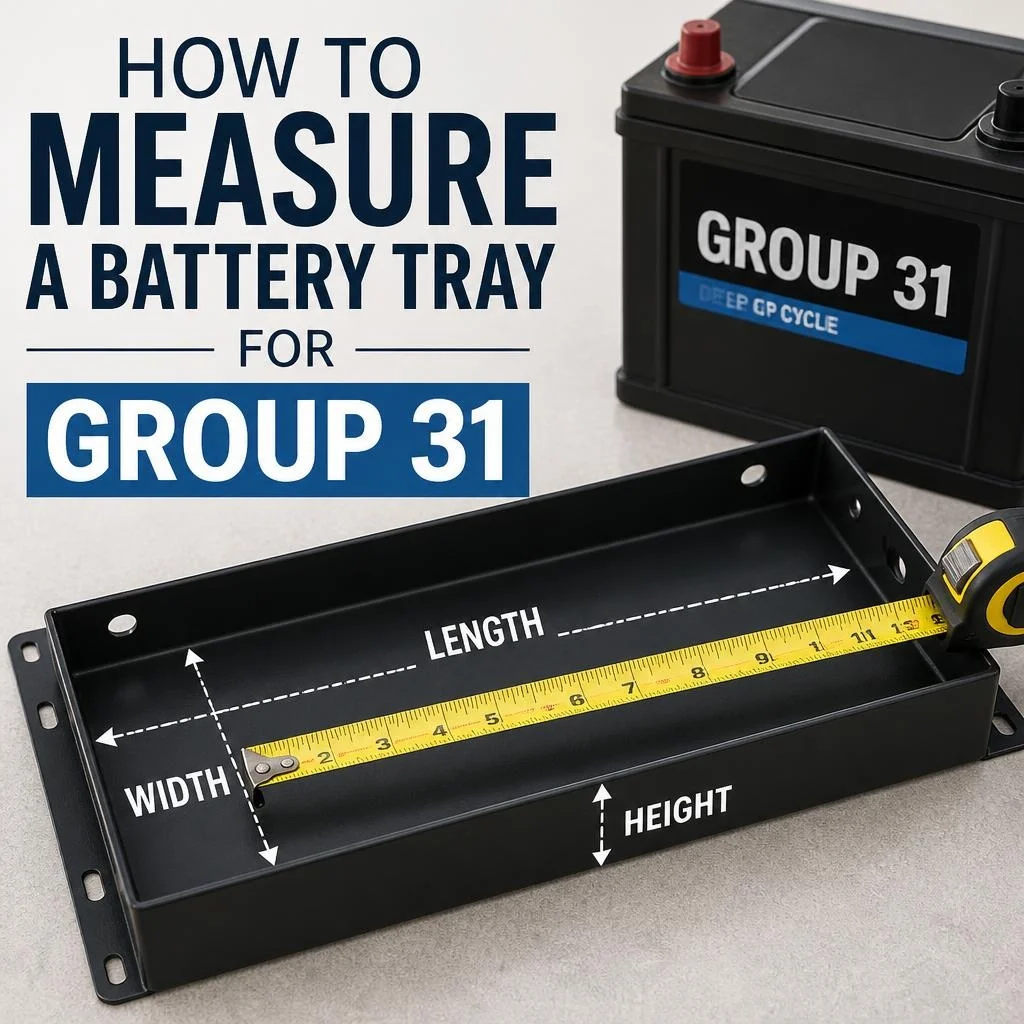
Measuring your battery compartment before buying a replacement can prevent installation problems.
Follow these steps:
Measure the Length
Use a measuring tape to check the longest available space inside the battery tray.
Compare that measurement with the Group 31 length of approximately 13 inches. Leave enough clearance for the case and any required mounting hardware.
Measure the Width
Measure the shorter side of the battery compartment.
A standard Group 31 battery has a width of approximately 6.81 inches. Make sure the tray can accommodate the battery without forcing it into place.
Measure the Height
Check the vertical space between the tray and any cover, hood, or nearby component.
Remember that the total battery height may include the terminals. A battery that fits at case level could still create a clearance problem at the top.
Check the Hold-Down
The battery must remain secure during normal vehicle operation. Check whether the existing hold-down system matches the replacement battery.
Do not rely on loose placement or improvised supports. Use an approved mounting arrangement.
Important Factors Before Buying a Group 31 Battery

Physical dimensions are only one part of choosing the right battery. You should also consider its electrical performance and compatibility.
Check the Manufacturer’s Requirements
Your vehicle or equipment manual should identify the recommended battery type and performance ratings.
Follow those requirements rather than choosing a battery only because it fits the compartment.
Compare the Terminal Layout
Check the positive and negative terminal positions. Incorrect placement can make cable connections difficult or unsafe.
Review the Charging System
Different battery technologies can have different charging requirements. Confirm that the charging system supports the battery you plan to install.
Consider the Intended Use
A starting battery is designed primarily to start an engine. A deep-cycle battery is designed for repeated energy use.
Dual-purpose models combine certain starting and cycling features. Choose the type that matches your equipment and daily use.
Check the Product’s Exact Dimensions
The BCI dimensions describe the group’s maximum overall size. Individual products may have different case dimensions, terminal heights, handles, or covers.
Always use the exact manufacturer’s specification sheet for final fitment.
Frequently Asked Questions
What are the dimensions of a Group 31 battery?
The standard maximum overall dimensions are approximately 13 inches long, 6.81 inches wide, and 9.44 inches high. In metric units, that equals 330 × 173 × 240 mm.
How many centimeters is a Group 31 battery?
A Group 31 battery measures approximately 33 cm long, 17.3 cm wide, and 24 cm high.
Is a Group 31 battery 12 volts?
Most standard automotive and commercial Group 31 batteries are 12-volt batteries. Always confirm the voltage on the product label before installation.
How much does a Group 31 battery weigh?
Many lead-acid Group 31 batteries weigh around 50 to 75 pounds. Actual weight depends on the manufacturer, internal construction, and battery technology.
How many amp-hours does a Group 31 battery have?
Capacity varies by model. Many Group 31 batteries offer around 100 Ah, but some have higher or lower ratings. Check the product label for the exact figure.
Is Group 31 bigger than Group 27?
Yes. Group 31 is approximately 13 inches long and 9.44 inches high. Group 27 is about 12.06 inches long and 8.88 inches high. Their widths are similar.
Are Group 31 batteries suitable for marine use?
Yes. Some Group 31 models are designed for marine applications. Check the battery’s marine rating, terminal type, mounting requirements, and intended use.
Can I replace a Group 27 battery with Group 31?
Not automatically. Group 31 is longer and taller than Group 27. You must check the available space, hold-down system, terminals, and equipment requirements before changing sizes.
What is the difference between Group 31A and Group 31T?
The main distinction is the terminal configuration. Group 31A generally uses Type A top-post terminals, while Group 31T uses a different terminal arrangement. Confirm the exact terminal design before buying.
Does Group 31 indicate battery capacity?
No. Group 31 identifies a physical battery size category. It does not guarantee a particular amp-hour rating, CCA, reserve capacity, or weight.
Conclusion
A standard Group 31 battery measures approximately 13 × 6.81 × 9.44 inches, or 330 × 173 × 240 millimeters. This makes it a relatively large battery commonly used in commercial trucks, buses, marine equipment, RVs, and industrial applications.
However, the group number does not determine the battery’s exact weight, capacity, or performance. Those specifications vary by manufacturer and battery technology.
Before choosing a replacement, measure the battery tray, check the terminal arrangement, confirm the hold-down system, and compare the electrical ratings. These steps help ensure that your Group 31 battery fits properly and meets your equipment’s requirements.

Lucas Morgan is a passionate writer who enjoys creating helpful, engaging, and practical content for readers. He focuses on sharing clear ideas, useful insights, and creative inspiration through every article.