
A soccer field is a large rectangular playing area where two teams compete to score goals. Its exact size can vary depending on the competition, age group, and level of play. However, professional soccer fields follow established measurement guidelines.
A common professional field measures 105 meters long and 68 meters wide. In US measurements, that equals approximately 344 feet long and 223 feet wide. The playing area covers about 7,140 square meters, or 76,875 square feet.
These measurements make a soccer field much larger than most people imagine. It provides enough room for players to pass, defend, attack, and move across the pitch throughout a match.
This guide explains standard soccer field dimensions, conversions into feet and yards, comparisons with American football fields, and the measurements of important areas such as the penalty box and goal area.
Standard Soccer Field Dimensions
Soccer fields must have a rectangular shape. The longer boundary lines are called touchlines, while the shorter boundary lines are called goal lines.
For international matches, FIFA’s Laws of the Game specify a length of 100 to 110 meters and a width of 64 to 75 meters. Other adult matches can use a wider permitted range.
A commonly used professional measurement is 105 meters by 68 meters.
| Measurement | Meters | Feet | Yards |
|---|---|---|---|
| Length | 105 m | 344.5 ft | 114.8 yd |
| Width | 68 m | 223.1 ft | 74.4 yd |
| Total area | 7,140 m² | 76,875 sq ft | 8,534 sq yd |
The 105-by-68-meter layout is a useful reference when visualizing a modern professional soccer field. However, not every field has exactly these dimensions.
How Long Is a Soccer Field?
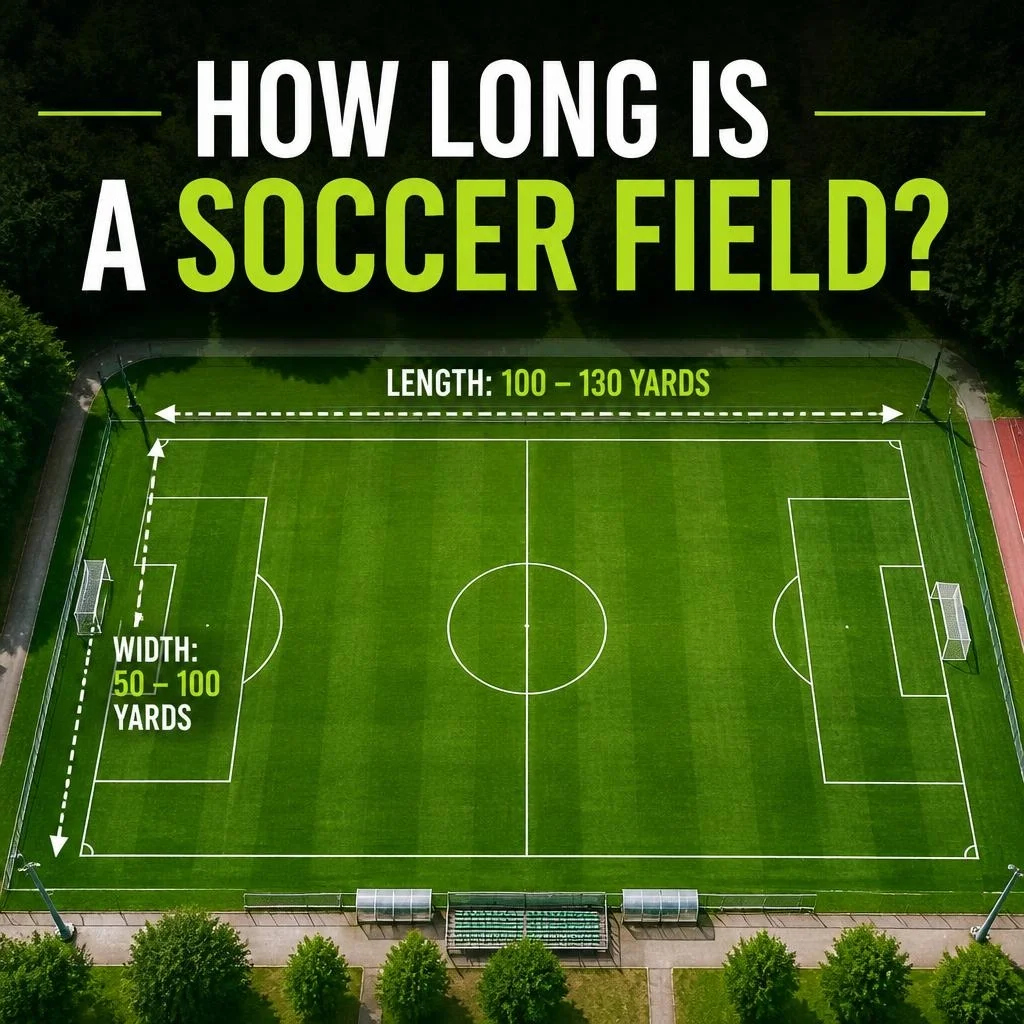
A typical professional soccer field is 105 meters long. That equals approximately 344.5 feet, or about 115 yards.
The length runs from one goal line to the opposite goal line. This distance gives teams room to build attacks, move the ball forward, and defend their own goal.
For international matches, the permitted length ranges from 100 to 110 meters. That is approximately 328 to 361 feet.
The exact length depends on the stadium and the competition rules. Therefore, a field you see on television may be slightly longer or shorter than another professional pitch.
How Wide Is a Soccer Field?
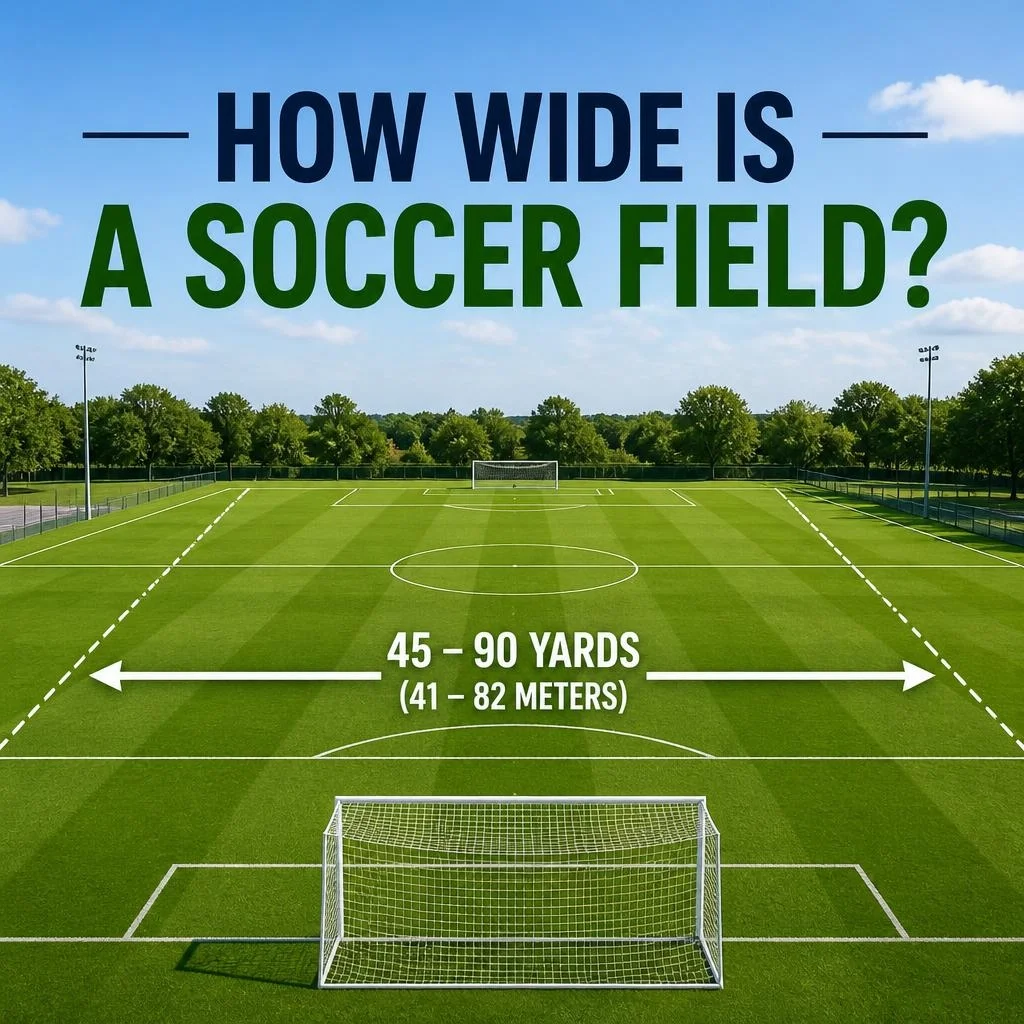
A common professional soccer field measures 68 meters wide. This equals approximately 223 feet, or 74.4 yards.
The width runs between the two touchlines. It gives players space to spread out, use the wings, and create passing opportunities.
For international matches, the permitted width ranges from 64 to 75 meters. In feet, that is approximately 210 to 246 feet.
A wider field can create more space for players to move and attack. However, teams must still follow the dimensions approved for their competition.
Soccer Field Size in Feet
People in the United States often use feet when measuring sports fields, buildings, and outdoor spaces.
A 105-by-68-meter soccer field converts to approximately 344.5 feet long and 223.1 feet wide.
| Soccer field measurement | Feet |
|---|---|
| Length | 344.5 ft |
| Width | 223.1 ft |
| Approximate area | 76,875 sq ft |
This means a standard professional soccer field covers a substantial area. It is much larger than a typical backyard or residential property.
Soccer Field Size in Yards
Yards are also useful when comparing soccer fields with American football fields.
A typical 105-by-68-meter soccer field measures approximately 114.8 yards long and 74.4 yards wide.
| Measurement | Yards |
|---|---|
| Length | 114.8 yd |
| Width | 74.4 yd |
| Area | 8,534 sq yd |
These figures describe the playing area, not additional space around the field. Stadiums usually need extra room for advertising boards, team areas, officials, and spectator facilities.
Soccer Field Size in Acres

A standard 105-by-68-meter field covers 7,140 square meters.
One acre contains 4,046.86 square meters. Therefore, a typical professional soccer field covers approximately 1.76 acres.
This comparison makes the field’s size easier to understand. If you imagine a piece of land measuring nearly two acres, you have a useful idea of the area required for a professional soccer pitch.
The actual property needed for a stadium field is larger because the playing surface does not include all surrounding facilities.
Soccer Field Compared With an American Football Field
Soccer and American football fields have different dimensions and markings.
An American football field measures 120 yards long when both end zones are included. Its width is 53⅓ yards.
A common professional soccer field measures approximately 114.8 yards long and 74.4 yards wide.
| Feature | Soccer field | American football field |
|---|---|---|
| Length | 114.8 yd | 120 yd |
| Width | 74.4 yd | 53.3 yd |
| Shape | Rectangle | Rectangle |
| Main markings | Center circle, penalty areas, goal areas | Yard lines, hash marks, end zones |
An American football field is slightly longer when its end zones are included. However, a soccer field is considerably wider.
This is why the two sports require different playing layouts, even though both use rectangular fields.
Soccer Field Compared With a Basketball Court
A regulation NBA basketball court measures 94 feet long and 50 feet wide.
By comparison, a typical professional soccer field measures approximately 344.5 feet long and 223.1 feet wide.
| Measurement | Soccer field | NBA basketball court |
|---|---|---|
| Length | 344.5 ft | 94 ft |
| Width | 223.1 ft | 50 ft |
| Area | 76,875 sq ft | 4,700 sq ft |
A soccer field is much larger than a basketball court. In fact, its playing area is more than 16 times the area of an NBA court.
This comparison shows why soccer players cover much greater distances during a match.
Important Soccer Field Markings and Dimensions
A soccer field contains several marked areas. Each one has a specific purpose under the Laws of the Game.
Center Circle

The center circle sits in the middle of the field around the halfway line.
Its radius measures 9.15 meters, or approximately 30 feet. Players from the opposing team must remain outside this circle during a kickoff until the ball is in play.
Penalty Area

The penalty area is the large rectangular box in front of each goal.
It extends 16.5 meters, or about 18 yards, from each goalpost along the goal line. It also extends 16.5 meters into the field.
The penalty area matters because certain fouls committed by defenders inside it can result in a penalty kick.
Goal Area

The goal area is the smaller rectangle inside the penalty area.
It extends 5.5 meters, or approximately 6 yards, from each goalpost. It also reaches 5.5 meters into the field.
This area is commonly called the six-yard box.
Penalty Spot

The penalty spot is located 11 meters from the midpoint between the goalposts. That equals approximately 12 yards.
Players take penalty kicks from this position when the referee awards one.
Corner Arc

A small quarter-circle marks each corner of the field.
The corner arc has a radius of 1 meter, or approximately 3.3 feet. Players place the ball inside this area when taking a corner kick.
Soccer Goal Dimensions
The goal sits in the middle of each goal line. It consists of two upright posts connected by a horizontal crossbar.
For standard adult soccer, the inside distance between the posts is 7.32 meters, or 8 yards. The distance from the ground to the underside of the crossbar is 2.44 meters, or 8 feet.
| Goal measurement | Metric | US measurement |
|---|---|---|
| Width | 7.32 m | 24 ft |
| Height | 2.44 m | 8 ft |
These measurements apply to standard adult goals. Youth soccer competitions may use smaller goals depending on the players’ age group and league rules.
Do All Soccer Fields Have the Same Size?

No. Soccer fields can have different dimensions.
The Laws of the Game allow a range of field sizes for adult matches. International matches have a narrower range than other adult games.
Youth leagues may also use smaller fields. This helps younger players develop their skills in a playing area that suits their age and physical abilities.
For example, a youth league may reduce the field length, width, goal size, and other markings. The exact measurements depend on the competition’s rules.
High School and Youth Soccer Field Dimensions

High school and youth soccer fields do not always match professional stadium dimensions.
In the United States, high school competitions follow their governing association’s rules. Youth leagues often create smaller playing areas for younger age groups.
A smaller field can make the game more manageable. It also helps players spend less time covering large distances and more time practicing passing, shooting, and teamwork.
Before building or marking a school or youth field, check the rules used by the relevant league or organization. Do not assume that every competition uses the professional 105-by-68-meter layout.
How Much Land Do You Need for a Soccer Field?

For a playing surface measuring 105 by 68 meters, you need 7,140 square meters of land.
That equals approximately 1.76 acres.
However, the playing surface is not the only space a facility needs. You may also need room for:
- Safety areas around the touchlines and goal lines
- Team benches and technical areas
- Referee and match official facilities
- Spectator seating
- Walkways and access routes
- Drainage and maintenance areas
As a result, a complete soccer facility usually requires more land than the playing area alone.
Frequently Asked Questions
How big is a standard soccer field?
A commonly used professional soccer field measures 105 meters long and 68 meters wide. That equals approximately 344.5 feet by 223.1 feet.
How many acres is a soccer field?
A 105-by-68-meter playing surface covers approximately 1.76 acres.
How many feet long is a soccer field?
A typical professional field is about 344.5 feet long. The permitted length can vary depending on the competition.
How many yards long is a soccer field?
A typical professional field measures approximately 114.8 yards long.
How wide is a professional soccer field?
A common professional field measures 68 meters wide, or approximately 223.1 feet.
Are soccer fields bigger than football fields?
Soccer fields are generally wider than American football fields. However, an American football field with its end zones is slightly longer than the common 105-meter soccer layout.
How big is a soccer goal?
A standard adult soccer goal is 8 yards wide and 8 feet high. In metric measurements, that is 7.32 meters wide and 2.44 meters high.
What is the size of the center circle?
The center circle has a radius of 9.15 meters, which is approximately 10 yards or 30 feet.
How far is the penalty spot from the goal?
The penalty spot is 11 meters, or 12 yards, from the midpoint between the goalposts.
Do youth soccer fields have the same dimensions?
No. Youth fields are often smaller than adult fields. Their dimensions depend on the players’ age group and the rules of the league.
Conclusion
A typical professional soccer field measures 105 meters long and 68 meters wide. In US measurements, that equals approximately 344.5 feet by 223.1 feet. The playing surface covers around 1.76 acres.
However, soccer fields do not all have identical dimensions. International matches follow a permitted range, while other adult and youth competitions may use different sizes.
The most useful reference is the 105-by-68-meter layout. It helps you visualize the size of a professional pitch and compare it with other sports fields, courts, and areas of land.

Lucas Morgan is a passionate writer who enjoys creating helpful, engaging, and practical content for readers. He focuses on sharing clear ideas, useful insights, and creative inspiration through every article.