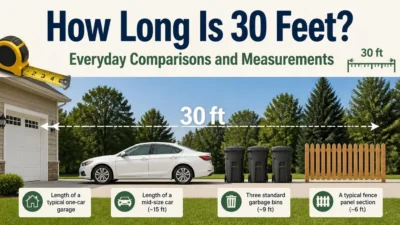

Five meters is a length of 500 centimeters, 5,000 millimeters, or approximately 16.4 feet. It is a little longer than a standard 16-foot room dimension and provides a useful reference for understanding larger everyday measurements.
Although meters are common in many countries, people in the United States often use feet and inches. Converting five meters into familiar units makes it easier to picture the distance when measuring a room, driveway, garden, vehicle space, or other object.
In this guide, you will learn exactly how long five meters is, how it compares with everyday objects, and how to measure it accurately.
Quick Answer: 5 Meters in Different Units
Five meters has several useful equivalents. Here is a quick conversion table:
| Measurement Unit | Equivalent |
|---|---|
| Meters | 5 m |
| Centimeters | 500 cm |
| Millimeters | 5,000 mm |
| Kilometers | 0.005 km |
| Feet | 16.404 ft |
| Inches | 196.85 in |
| Yards | 5.468 yd |
The most useful conversions are:
- 5 meters = 500 centimeters
- 5 meters = 5,000 millimeters
- 5 meters = 16.4 feet
- 5 meters = 196.85 inches
- 5 meters = approximately 5.47 yards
For a quick mental estimate, think of five meters as a little over 16 feet.
How Long Is 5 Meters in Feet?

Five meters equals approximately 16.4 feet.
To convert meters into feet, multiply the measurement by 3.28084.
The calculation is:
5 × 3.28084 = 16.4042 feet
Therefore, five meters is approximately 16 feet and 4.85 inches.
This conversion is particularly helpful when planning room layouts, measuring outdoor spaces, or comparing dimensions with products that use the US customary system.
For example, a 16-foot wall is slightly shorter than five meters. The difference is about 4.85 inches.
How Long Is 5 Meters in Inches?

Five meters equals approximately 196.85 inches.
One meter contains 39.3701 inches. Therefore:
5 × 39.3701 = 196.8505 inches
This means a five-meter distance is just under 197 inches.
In practical terms, it is much longer than a standard 12-inch ruler. You would need more than 16 standard rulers placed end to end to cover the same distance.
How Long Is 5 Meters in Centimeters?

Five meters equals exactly 500 centimeters.
One meter contains 100 centimeters, so the calculation is simple:
5 × 100 = 500 cm
This makes five meters easy to understand with a metric measuring tape. Simply follow the tape until you reach the 500-centimeter marking.
It is also useful to divide the distance into smaller sections. For example, five sections of one meter each create a total length of five meters.
How Long Is 5 Meters in Millimeters?

Five meters equals exactly 5,000 millimeters.
Since one meter contains 1,000 millimeters:
5 × 1,000 = 5,000 mm
Millimeters are useful when measuring small details or working with construction materials. However, for a distance as large as five meters, meters or centimeters are usually easier to read.
What Does 5 Meters Look Like?

A number alone may not help you picture a distance. Everyday comparisons make the measurement easier to understand.
Five meters is approximately the length of a large living-room wall, depending on the home’s design. It can also represent the distance across a small outdoor area or the length of several large household objects placed in a straight line.
The following examples provide useful visual references. Actual object dimensions vary by model and design.
Five Meters Compared With a Car

Many passenger cars measure approximately 4 to 5 meters long, depending on the vehicle type.
For example, some large sedans and SUVs approach five meters in overall length. This makes a full-size vehicle a helpful reference when visualizing the distance.
A compact car, however, is usually shorter. Therefore, not every car will cover the full five-meter length.
When measuring a parking space, remember that the vehicle’s length is only one part of the calculation. You also need extra room for movement, doors, and safe access.
Five Meters Compared With a Room

A room that measures five meters along one wall has a length of approximately 16.4 feet.
This is a useful size for visualizing a medium-to-large room. Depending on the room’s width, it may provide space for furniture, walking areas, and storage.
For example, a rectangular room measuring 5 meters by 4 meters has a floor area of 20 square meters.
However, the five-meter measurement describes only one side. It does not tell you the room’s total area or volume.
Five Meters Compared With a Basketball Court

A regulation NBA basketball court measures 94 feet long, which is approximately 28.65 meters.
Five meters is much shorter than the full court. It represents about 17.5% of the court’s length.
This comparison is useful because basketball courts provide a familiar reference for many people in the United States.
Five meters would cover only a small section of the playing surface, rather than reaching from one baseline to the other.
Five Meters Compared With a Swimming Pool

Many residential swimming pools have lengths around 5 to 10 meters, although their dimensions vary considerably.
A five-meter distance could represent the short side of a small rectangular pool or a section of a larger pool.
For comparison, a standard Olympic swimming pool measures 50 meters long. Five meters is exactly one-tenth of that length.
This makes a swimming pool another helpful way to understand the measurement.
Five Meters Compared With a Pickup Truck

Many pickup trucks measure roughly 5 to 6 meters long, depending on the cab and bed configuration.
Some smaller configurations are shorter, while large crew-cab models with long beds can exceed five meters.
A pickup truck can therefore provide a rough visual comparison. However, check the manufacturer’s specifications if you need an exact measurement.
Five Meters Compared With a 16-Foot Object

A 16-foot object measures 4.8768 meters.
Five meters is therefore approximately 4.85 inches longer than 16 feet.
This is a small difference compared with the overall length, but it can matter when measuring materials or planning a precise installation.
If you are working with a 16-foot board, pipe, or other material, do not treat it as exactly five meters.
How Many Steps Does It Take to Walk 5 Meters?
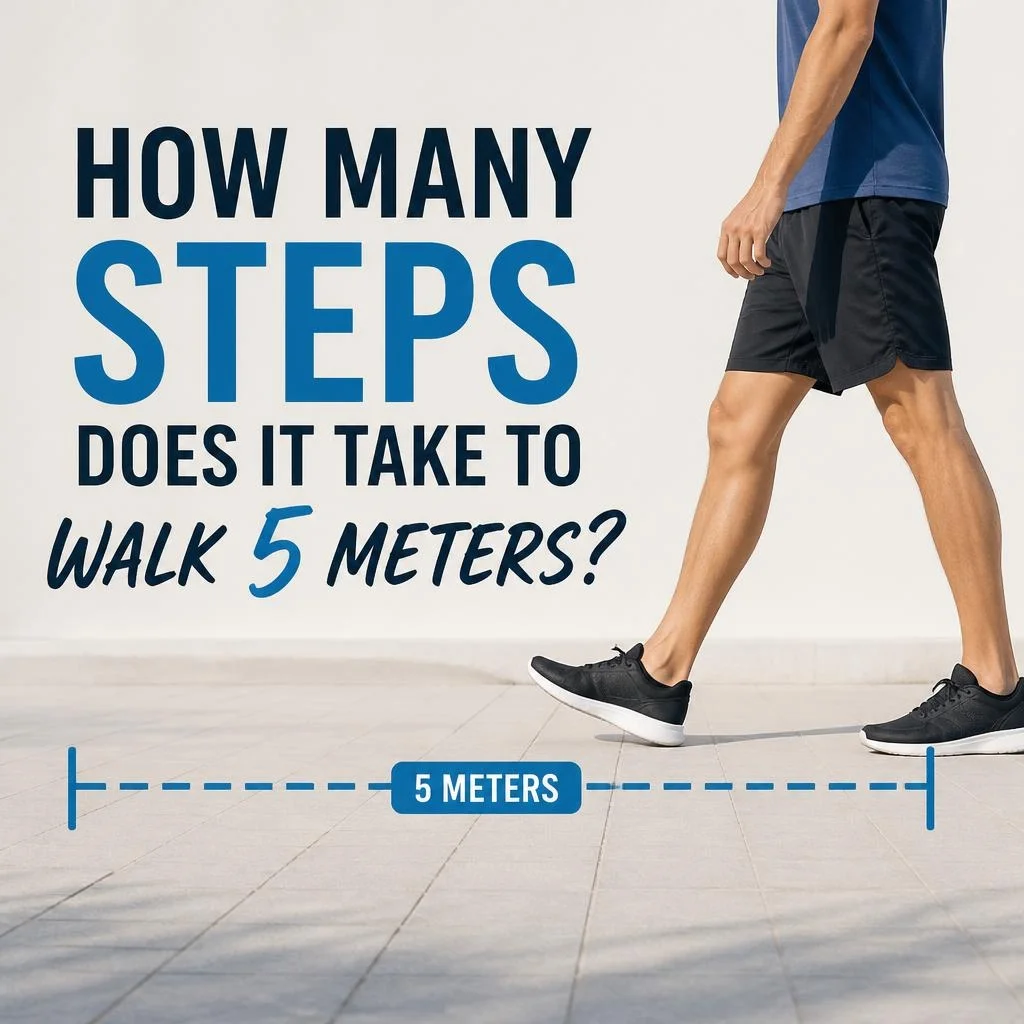
The number of steps depends on your stride length.
For an adult with an average walking step of approximately 0.7 to 0.8 meters, five meters may take around 6 to 8 steps.
This is only a rough estimate. Your walking speed, height, and natural stride can change the number.
For accurate distance measurement, use a measuring tape rather than counting steps.
How to Measure 5 Meters Without Guessing

If you need an accurate five-meter measurement, a measuring tape is the simplest option.
Using a Metric Measuring Tape
Place the beginning of the tape at your starting point. Extend it in a straight line until it reaches the 5-meter mark.
Make sure the tape stays straight and does not bend or curve. This gives you a direct measurement of five meters.
Using a Feet-and-Inches Tape
If your measuring tape uses feet and inches, look for approximately 16 feet and 4.85 inches.
Some tapes may not display this exact value clearly. In that case, use the nearest marked measurement and account for the small difference.
Using a One-Meter Measuring Stick
If you have a one-meter measuring stick, place it end to end five times.
Each section represents one meter. Together, the five sections equal exactly five meters.
Keep the stick aligned in a straight line to avoid measurement errors.
Common Places Where 5 Meters Is Useful

A five-meter measurement appears in many everyday situations.
Home Improvement
Five meters can describe the length of a wall, flooring section, curtain track, or cable run.
Always measure the available space before purchasing materials. Also allow extra material when a project requires cutting, joining, or fitting.
Construction Projects
Builders may use five-meter measurements when planning material lengths, room layouts, and outdoor structures.
However, building plans should use the exact dimensions and units required by the project.
Gardening and Landscaping
A five-meter distance can help plan garden beds, fences, pathways, and outdoor seating areas.
It is also useful when estimating the space between trees or other landscape features.
Sports and Recreation
Five meters can describe a short training distance, a section of a playing area, or a swimming-pool measurement.
Sports organizations often use specific official dimensions, so check the relevant rules when accuracy matters.
Vehicle Parking
Five meters can help you understand the approximate length of a parking space or vehicle.
However, parking-space requirements vary by location and design. Always check local standards before planning a parking area.
Frequently Asked Questions
How many feet are in 5 meters?
Five meters equals approximately 16.4 feet, or 16 feet and 4.85 inches.
How many inches are in 5 meters?
Five meters equals approximately 196.85 inches.
How many centimeters are in 5 meters?
There are exactly 500 centimeters in five meters.
How many millimeters are in 5 meters?
Five meters equals exactly 5,000 millimeters.
Is 5 meters longer than 15 feet?
Yes. Five meters equals approximately 16.4 feet, making it about 1.4 feet longer than 15 feet.
Is 5 meters the same as 5 yards?
No. Five meters equals approximately 5.47 yards. It is about 0.47 yards longer than five yards.
How many steps does it take to walk 5 meters?
It may take around 6 to 8 steps for an adult, depending on stride length. This is only an estimate.
Is 5 meters a long distance?
It depends on the situation. Five meters is a substantial distance for a household object but relatively short for a road, swimming pool, or sports field.
How can I visualize 5 meters?
Think of a distance of approximately 16.4 feet. A large vehicle or a room wall may provide a useful visual reference, depending on its actual dimensions.
Conclusion
Five meters is a length equal to 500 centimeters, 5,000 millimeters, 196.85 inches, and approximately 16.4 feet. It is a useful measurement for understanding room layouts, vehicle lengths, construction materials, and outdoor spaces.
For an easy visual reference, imagine a line slightly longer than 16 feet. You can also picture five one-meter sections placed end to end.
When exact measurements matter, use a measuring tape and check the dimensions of the object or space rather than relying only on visual comparisons.

Lucas Morgan is a passionate writer who enjoys creating helpful, engaging, and practical content for readers. He focuses on sharing clear ideas, useful insights, and creative inspiration through every article.