

A measurement of seven inches may seem simple, but it can be surprisingly difficult to visualize without a ruler or familiar object nearby. If you need to understand this length for a product, home project, craft, clothing measurement, or everyday comparison, knowing its exact conversions makes the size much easier to picture.
Seven inches equals 17.78 centimeters, 177.8 millimeters, 0.1778 meters, and 0.5833 feet. It is also just one inch longer than half a foot and five inches shorter than a full foot.
For readers in the United States, inches are the most natural way to describe this measurement. Still, centimeters and millimeters can make the size easier to understand when comparing it with objects or measurements from metric-based specifications.
This guide breaks down the length, provides accurate conversions, and compares it with familiar everyday objects so you can get a clear sense of the actual size.
7 Inches at a Glance
Here are the most important conversions:
| Measurement | Equivalent |
|---|---|
| Inches | 7 inches |
| Centimeters | 17.78 cm |
| Millimeters | 177.8 mm |
| Meters | 0.1778 m |
| Feet | 0.5833 ft |
| Yards | 0.1944 yd |
| Fraction of a foot | 7/12 |
| Fraction of a yard | 7/36 |
The most useful conversions for everyday purposes are 7 inches = 17.78 cm and 7 inches = 0.5833 feet.
If you only need an approximate metric value, you can think of it as about 18 centimeters.
How Long Is 7 Inches?
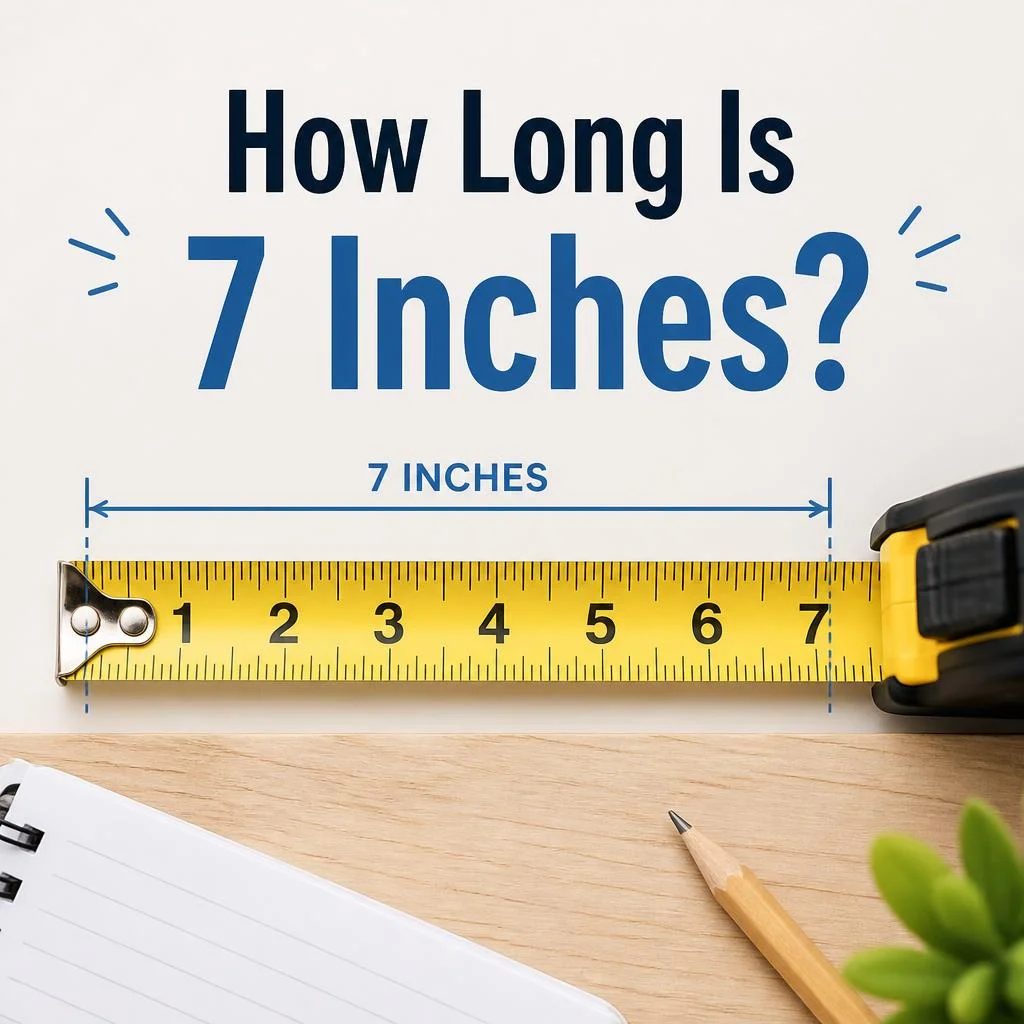
A seven-inch length measures exactly 7 inches from one end to the other.
Because one foot contains 12 inches, the measurement falls well below a full foot:
12 − 7 = 5 inches
So, seven inches is five inches shorter than one foot.
It is also one inch longer than six inches, which represents exactly half a foot. That makes the measurement slightly more than half of a standard 12-inch ruler.
When visualizing it, imagine a ruler extending from zero to the seven-inch mark. The distance covered by those seven markings represents the entire length.
7 Inches in Centimeters

Seven inches equals 17.78 centimeters.
The standard conversion is:
1 inch = 2.54 centimeters
Therefore:
7 × 2.54 = 17.78 centimeters
So if a product specification says that something is seven inches long, its metric equivalent is 17.78 cm.
For a quick estimate, you can round this to 18 cm, although the exact value remains 17.78 cm.
This conversion can help when comparing American product dimensions with measurements listed by manufacturers using the metric system.
7 Inches in Millimeters

The same length equals 177.8 millimeters.
Since one inch contains 25.4 millimeters:
7 × 25.4 = 177.8 mm
Therefore:
7 inches = 177.8 mm
For everyday calculations, you may see this rounded to approximately 178 mm.
Millimeters provide a more precise way to describe smaller objects. They are especially useful for hardware, construction materials, electronics, woodworking, and manufacturing specifications.
7 Inches in Feet

There are 12 inches in one foot.
To convert seven inches into feet:
7 ÷ 12 = 0.5833 feet
Therefore:
7 inches = 0.5833 feet
This number can also be expressed as 7/12 of a foot.
Seven inches does not equal 0.7 feet because inches and decimal feet use different conversion factors. One foot always contains 12 inches.
For practical measurements in the United States, saying 7 inches is usually clearer than saying 0.5833 feet.
7 Inches in Meters

Seven inches equals 0.1778 meters.
The calculation is:
7 × 0.0254 = 0.1778 meters
Rounded to two decimal places, that becomes 0.18 meters.
Because 1 meter equals 100 centimeters, the same measurement can also be written as:
17.78 cm = 0.1778 m
This metric conversion becomes useful when comparing the size with international product specifications or engineering measurements.
7 Inches in Yards

One yard contains 36 inches.
Therefore:
7 ÷ 36 = 0.1944 yards
So the measurement equals approximately 0.1944 yards.
A quarter of a yard equals nine inches, meaning seven inches is two inches shorter than one-quarter yard.
Yards are generally more useful for longer distances, fabric, sports fields, and large areas, so inches remain the more practical unit for a seven-inch object.
Is 7 Inches More Than Half a Foot?
Yes.
Half of a foot equals six inches because:
12 ÷ 2 = 6
Seven inches is therefore exactly one inch longer than half a foot.
You can think of a 12-inch ruler divided into two equal sections. Each section would measure six inches. Extending either section by one additional inch gives you seven inches.
This makes seven inches slightly more than half the length of a standard ruler.
Is 7 Inches Close to a Foot?

Yes, but it is noticeably shorter.
A full foot measures 12 inches, while this length measures seven inches.
The difference is:
12 − 7 = 5 inches
So it is about 58.3% of a foot.
Another way to look at it is that you would need another five inches to reach the 12-inch mark.
For everyday visualization, imagine a standard ruler. Seven inches takes up a little more than half its total length.
Comparing the Measurement With a U.S. Dollar Bill
A U.S. dollar bill is 6.14 inches long.
That makes seven inches slightly longer than the long side of a dollar bill.
The difference is:
7 − 6.14 = 0.86 inch
So you can visualize the measurement as a dollar bill plus roughly 0.86 inch.
In metric terms, a dollar bill is about 15.6 cm long, while seven inches equals 17.78 cm.
This is one of the easiest household comparisons for Americans because a dollar bill is readily available and has a standardized size.
Comparing It With a Standard Ruler

A typical school ruler measures 12 inches long.
Seven inches represents:
7/12 of the ruler
That equals approximately 58.3% of its total length.
If you place an object next to a 12-inch ruler, the object would reach the seven-inch marking if it measured exactly seven inches.
This is more accurate than using your hand or another object because ruler markings provide a direct reference.
Keep in mind that some rulers have metric measurements on the opposite edge, allowing you to see that seven inches corresponds to 17.78 cm.
Comparing It With a Smartphone
Smartphones provide another useful visual reference, but you need to understand how phone dimensions work.
Most smartphones have a total height somewhere around five to seven inches, depending on the model.
That means a seven-inch length can be similar to the overall height of some larger smartphones.
However, you should not assume every phone is seven inches tall.
For example, a phone with a six-inch display does not necessarily measure six inches from top to bottom. Display size usually refers to the diagonal measurement of the screen, not the phone’s physical height.
The case, bezels, camera area, and frame also contribute to the phone’s total dimensions.
A 7-Inch Screen Is Not 7 Inches Wide
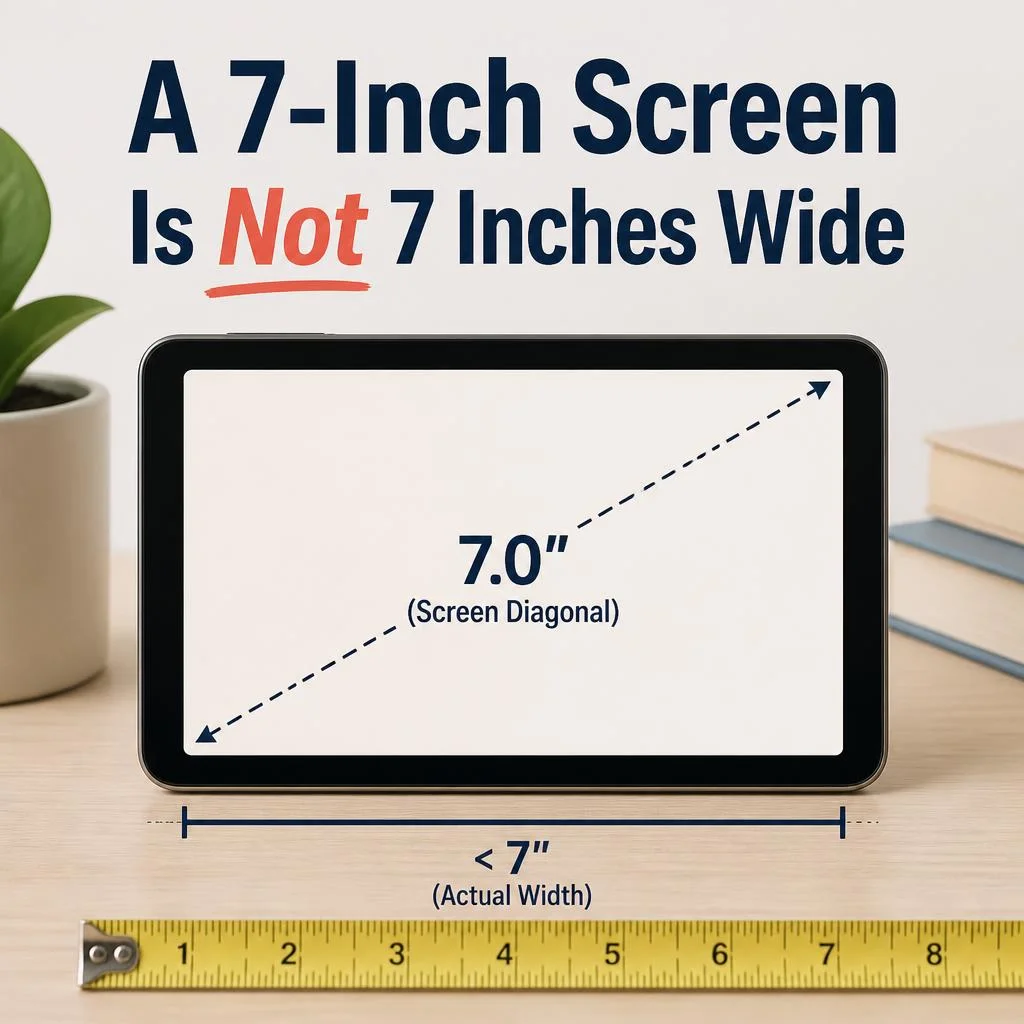
This distinction is especially important when shopping for electronics.
When a manufacturer describes a display as seven inches, the number usually refers to the diagonal distance across the screen.
It does not mean the display is seven inches wide.
For a rectangular screen, the diagonal is longer than either the width or height. The exact dimensions depend on the screen’s aspect ratio.
Therefore, a seven-inch tablet, monitor, or display can have a physical width considerably smaller than seven inches.
If you are buying an electronic device, always check the manufacturer’s listed width, height, and depth rather than relying only on the diagonal screen measurement.
Comparing It With a Pencil
A standard wooden pencil often measures around seven to eight inches when new, although manufacturers and pencil styles vary.
That makes a typical full-length pencil a useful approximate visual reference.
A seven-inch object would be roughly comparable to a pencil that measures seven inches from end to end.
However, pencil length changes as you sharpen and use it. Mechanical pencils also have very different dimensions.
For an exact comparison, measure the specific pencil rather than assuming all pencils have the same length.
Comparing It With a Dinner Plate
Seven inches is also useful when thinking about the diameter of smaller plates.
Many small plates, dessert plates, and side plates measure around seven inches across, although sizes vary by manufacturer.
A seven-inch diameter means the distance from one edge through the center to the opposite edge is seven inches.
That does not mean the circumference is seven inches.
For a circular object, diameter and circumference describe different measurements.
A seven-inch circle has a circumference of approximately:
7 × π ≈ 21.99 inches
So if you are measuring a round object, make sure you know whether the specification refers to diameter, radius, or circumference.
7 Inches Compared With a Credit Card

A standard U.S. credit card measures approximately 3.375 inches wide and 2.125 inches tall.
Seven inches is therefore a little more than twice the card’s width.
Specifically:
3.375 × 2 = 6.75 inches
So seven inches is only 0.25 inch longer than two credit-card widths placed side by side.
This provides a surprisingly useful way to visualize the measurement.
Two standard credit cards positioned along their longer edges would measure approximately 6.75 inches. Adding another quarter inch brings the total to seven inches.
7 Inches Compared With a Baseball

A regulation baseball has a circumference of approximately 9 to 9.25 inches, which means its diameter is only around 2.86 to 2.94 inches.
That means seven inches is much longer than the diameter of a baseball.
If you placed two baseball diameters next to each other, you would get roughly 5.7 to 5.9 inches. Three diameters would be around 8.6 to 8.8 inches.
Therefore, seven inches is roughly two and a half baseball diameters.
This comparison is approximate because baseball dimensions fall within a range.
7 Inches Compared With a Golf Ball

A standard golf ball has a diameter of at least 1.68 inches.
Seven inches divided by 1.68 gives approximately:
4.17
So seven inches is a little more than four golf-ball diameters placed end to end.
Four golf balls would measure approximately:
1.68 × 4 = 6.72 inches
Adding another 0.28 inch brings the total to seven inches.
This makes golf balls a useful visual reference for understanding the length.
7 Inches Compared With a U.S. Quarter

A U.S. quarter has a diameter of approximately 0.955 inch.
Seven inches is therefore more than seven quarter diameters.
The calculation is:
7 ÷ 0.955 ≈ 7.33
So seven inches is approximately 7.3 quarter diameters.
This is not as convenient as using a dollar bill or ruler, but it demonstrates how the measurement relates to a familiar U.S. object.
7 Inches Compared With a Human Hand
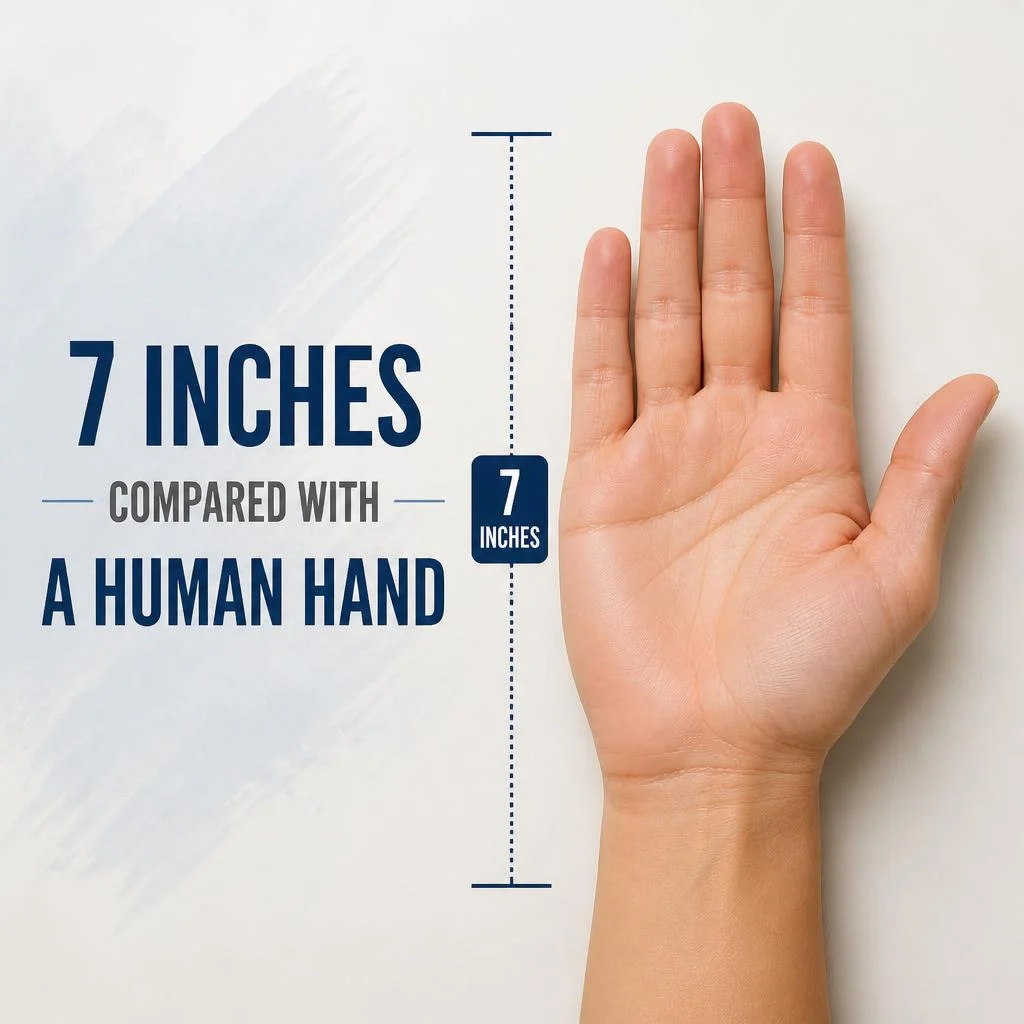
People often use their hands to estimate measurements when they do not have a ruler.
However, hand sizes vary significantly.
For some adults, the distance from the wrist to the end of the middle finger may approach seven inches. For others, it may be shorter or longer.
Because of this variation, your hand can provide only a rough estimate.
If you want to use your hand as a quick reference, measure your own hand once with a ruler. Then you will know whether your particular hand provides a reasonable seven-inch reference.
7 Inches Compared With an Adult Foot

A typical adult foot is often somewhere around nine to twelve inches long, depending on the person.
Seven inches is therefore shorter than most adult feet.
For someone with a 10-inch foot, for example, seven inches would represent:
7/10 = 70%
of the foot’s length.
This comparison is only illustrative because shoe size and actual foot length vary considerably.
You should not use a person’s shoe size as an exact measurement tool.
7 Inches in Clothing and Sewing

Seven inches can appear in clothing measurements, sewing projects, hems, seams, pockets, cuffs, and fabric patterns.
For sewing, precision matters. A difference of even half an inch can affect the final appearance or fit of a garment.
If a pattern calls for a seven-inch section, use a measuring tape or ruler instead of estimating with your hand.
In fabric work, you may also encounter measurements expressed in fractions such as 1/4, 1/2, or 3/4 inch. Seven inches can therefore appear alongside many smaller measurements.
7 Inches in Home Improvement

A seven-inch measurement can also appear in home projects.
Examples include:
- Shelf spacing
- Trim pieces
- Cabinet components
- Tile dimensions
- Wood cuts
- Hardware placement
- Picture-frame measurements
- Small storage compartments
When working with construction materials, always measure twice before cutting.
A seven-inch difference can be significant in a tight installation, particularly when several pieces must fit together.
7 Inches in Food and Kitchen Measurements

Kitchen products can also use seven-inch dimensions.
Small plates, bowls, cutting tools, serving dishes, baking accessories, and other products may have dimensions close to seven inches.
For circular kitchenware, remember that the listed seven-inch measurement may represent diameter rather than the length of one side.
For rectangular items, manufacturers may list dimensions in order, such as:
7 × 5 × 2 inches
In that example, seven inches describes the longest dimension, five inches describes the second dimension, and two inches describes depth.
Is 7 Inches Considered Big?
Whether seven inches feels “big” depends entirely on what you are measuring.
For a ruler, it is more than half the total length.
For a smartphone, it can be close to the overall height of some large models.
For a dinner plate, it represents a relatively small diameter.
For a table or countertop, seven inches is a short distance.
For a small household object, however, seven inches can be a substantial length.
The word “big” therefore needs context. The exact measurement is objective, but its practical size depends on the object involved.
How to Measure 7 Inches Without a Ruler

If you do not have a ruler available, you can estimate the length using familiar objects.
A U.S. dollar bill provides one option because its long side measures 6.14 inches. Add approximately 0.86 inch to reach seven inches.
You can also use two credit-card widths. Two widths total about 6.75 inches, so another quarter inch gets you close to seven.
Another option is to use a smartphone after checking its actual physical height.
These methods are useful for rough estimates, but they should not replace a ruler when accuracy matters.
Why Exact Measurements Matter
Visual comparisons can help you understand size, but they are not substitutes for exact measurements.
For example, saying that seven inches is “about the length of a pencil” provides a useful mental picture. Yet pencils vary in length.
Similarly, saying that the measurement is “about the length of a smartphone” may help you visualize it, but smartphone dimensions vary from one model to another.
The exact figure remains:
7 inches = 17.78 cm = 177.8 mm
Use the exact conversion whenever precision matters.
Quick Comparison Table
| Object or Measurement | Approximate Size | How It Compares |
|---|---|---|
| Half a foot | 6 in | 1 inch shorter |
| U.S. dollar bill | 6.14 in | 0.86 inch shorter |
| Two credit-card widths | 6.75 in | 0.25 inch shorter |
| Seven-inch measurement | 7 in | Reference |
| Quarter yard | 9 in | 2 inches longer |
| One foot | 12 in | 5 inches longer |
| Golf ball diameter | 1.68 in | About 4.17 diameters |
| Credit-card width | 3.375 in | About 2.07 widths |
These comparisons provide approximate visual references. Object dimensions can vary slightly depending on the product or standard being used.
Common Mistakes When Measuring Seven Inches

Several simple mistakes can lead to incorrect measurements.
Confusing Inches With Centimeters
Seven inches is 17.78 cm, not 7 cm.
The two units have very different lengths.
Confusing Decimal Feet With Feet and Inches
Seven inches equals 0.5833 feet, not 0.7 feet.
If a measurement is written as 5.7 feet, that does not mean 5 feet 7 inches. Decimal feet require a separate conversion.
Measuring Screen Size as Width
A seven-inch display usually refers to diagonal screen size. The screen’s width will be smaller.
Ignoring Object Shape
A seven-inch diameter is different from a seven-inch side length.
Always identify whether the measurement refers to length, width, height, diameter, depth, or diagonal.
Frequently Asked Questions
How many centimeters are in 7 inches?
Seven inches equals 17.78 centimeters.
How many millimeters are in 7 inches?
Seven inches equals 177.8 millimeters.
How many feet is 7 inches?
Seven inches equals approximately 0.5833 feet, or exactly 7/12 of a foot.
Is 7 inches half a foot?
No. Half a foot is six inches. Seven inches is one inch longer than half a foot.
Is 7 inches close to a foot?
Yes. A foot is 12 inches, so seven inches is five inches shorter than a full foot.
Is 7 inches longer than a dollar bill?
Yes. A U.S. dollar bill is 6.14 inches long, making seven inches approximately 0.86 inch longer.
What common object is about 7 inches long?
A full-size pencil can be close to seven inches, and some small plates or larger smartphones can also have dimensions around this length. Exact sizes vary.
How many golf balls equal 7 inches?
A regulation golf ball has a diameter of about 1.68 inches. Seven inches equals approximately 4.17 golf-ball diameters.
How many credit cards equal 7 inches?
Two standard credit-card widths total about 6.75 inches, so seven inches is only about 0.25 inch longer than two widths.
Is 7 inches the same as 7 square inches?
No. Seven inches measures length, while seven square inches measures area.
How do I measure 7 inches accurately?
Use a ruler, measuring tape, or another calibrated measuring tool. For rough estimates, a U.S. dollar bill or two credit-card widths can provide visual references.
Conclusion
Seven inches is a moderate everyday length that equals 17.78 centimeters, 177.8 millimeters, 0.1778 meters, and 0.5833 feet. It is slightly more than half a foot and five inches shorter than a full foot.
For a U.S. audience, one of the easiest ways to visualize the measurement is to compare it with a standard dollar bill. Since a dollar bill is 6.14 inches long, seven inches extends about 0.86 inch beyond it.
Other useful references include two credit-card widths, a standard ruler, a full-length pencil, a small plate, and certain smartphone dimensions. Each comparison gives a different perspective, but the exact measurement remains 7 inches or 17.78 cm.
Whether you are checking a product size, planning a home project, working on a craft, comparing electronics, or simply trying to visualize a measurement, these conversions and everyday examples make the size much easier to understand.

Lucas Morgan is a passionate writer who enjoys creating helpful, engaging, and practical content for readers. He focuses on sharing clear ideas, useful insights, and creative inspiration through every article.


