
Kylian Mbappé is one of the most recognizable footballers in the world. Fans admire his incredible speed, quick footwork, accurate finishing, and ability to create scoring opportunities. His athletic build also attracts attention, especially among readers who search for his height, weight, and body measurements.
Mbappé represents France at the international level and plays professional football for Real Madrid. His physical qualities help him handle the demands of elite football, including rapid acceleration, sharp turns, and repeated sprints. However, measurements alone cannot explain his success because technique, training, and tactical awareness also matter.
This guide explores Kylian Mbappé’s reported physical statistics, converts them into familiar measurement units, and explains how his height and athletic build relate to his playing style.
Kylian Mbappé Body Measurements at a Glance
Official football profiles provide the clearest starting point for researching Mbappé’s physical statistics. His listed height is 178 centimeters, although his recorded weight differs between major football sources. Therefore, readers should check the source whenever they use a specific weight figure.
| Physical detail | Measurement or information |
|---|---|
| Full name | Kylian Mbappé Lottin |
| Date of birth | December 20, 1998 |
| Nationality | French |
| Height | 178 cm |
| Height in meters | 1.78 m |
| Height in feet and inches | Approximately 5 ft 10 in |
| Height in total inches | Approximately 70.08 in |
| Weight on Real Madrid’s profile | 75 kg (165.3 lb) |
| Weight on UEFA’s profile | 67 kg (147.7 lb) |
| Playing position | Forward |
| Preferred foot | Right |
These figures cover the most useful publicly listed statistics. However, official football profiles do not consistently provide exact chest, waist, or biceps measurements. For accuracy, this article avoids assigning unsupported numbers to those details.
How Tall Is Kylian Mbappé?

Kylian Mbappé stands at a listed height of 178 centimeters, equivalent to 1.78 meters. In the United States, people commonly express this measurement as approximately 5 feet 10 inches.
This height gives readers a straightforward reference for comparing Mbappé with other footballers and everyday measurements. Nevertheless, height does not determine a player’s overall ability. Speed, balance, coordination, strength, and decision-making all influence performance on the pitch.
For example, an attacking player often needs to accelerate quickly, move around defenders, and control the ball while running. Mbappé combines his physical attributes with technical skills that help him create chances and finish attacks.
Height Conversion Table
The following conversions make Mbappé’s listed height easier to understand in different measurement systems.
| Unit | Equivalent |
|---|---|
| Centimeters | 178 cm |
| Meters | 1.78 m |
| Millimeters | 1,780 mm |
| Total inches | 70.08 inches |
| Decimal feet | 5.84 ft |
| Feet and inches | Approximately 5 ft 10 in |
To convert centimeters into inches, divide the measurement by 2.54. Therefore, 178 centimeters equals approximately 70.08 inches. Since 12 inches make one foot, this measurement converts to about 5 feet 10.08 inches.
For everyday use, most people round the result to 5 feet 10 inches. This small rounding difference is normal when converting metric measurements into feet and inches.
Is Mbappé Exactly 5 Feet 10 Inches Tall?
Mbappé’s listed height of 178 cm converts to approximately 5 feet 10.08 inches. As a result, 5 feet 10 inches serves as a convenient rounded figure.
Different sources may round measurements differently. However, the conversion itself remains consistent because one inch always equals 2.54 centimeters.
How Much Does Kylian Mbappé Weigh?

Mbappé’s listed weight varies between official football profiles. Real Madrid reports 75 kilograms, while UEFA lists 67 kilograms. These values equal approximately 165.3 pounds and 147.7 pounds, respectively.
Because these sources disagree, readers should not assume that either figure represents his current weight in every situation. Different reporting dates and profile updates may explain some differences, but the figures alone do not establish the reason.
Weight can also change over time. Hydration, training, nutrition, and normal body fluctuations can affect an athlete’s measurement. Therefore, a published weight should serve as a reference rather than a permanent description of the player’s physique.
Kilograms to Pounds Conversion
Readers in the United States often use pounds instead of kilograms. This table shows several common conversions for comparison.
| Kilograms | Pounds |
|---|---|
| 60 kg | 132.3 lb |
| 65 kg | 143.3 lb |
| 67 kg | 147.7 lb |
| 70 kg | 154.3 lb |
| 73 kg | 160.9 lb |
| 75 kg | 165.3 lb |
| 80 kg | 176.4 lb |
To convert kilograms into pounds, multiply the kilogram value by approximately 2.20462. For instance, 75 kilograms equals about 165.35 pounds.
This simple calculation helps readers compare international sports statistics with measurements used in the United States.
What Is Mbappé’s Body Type?
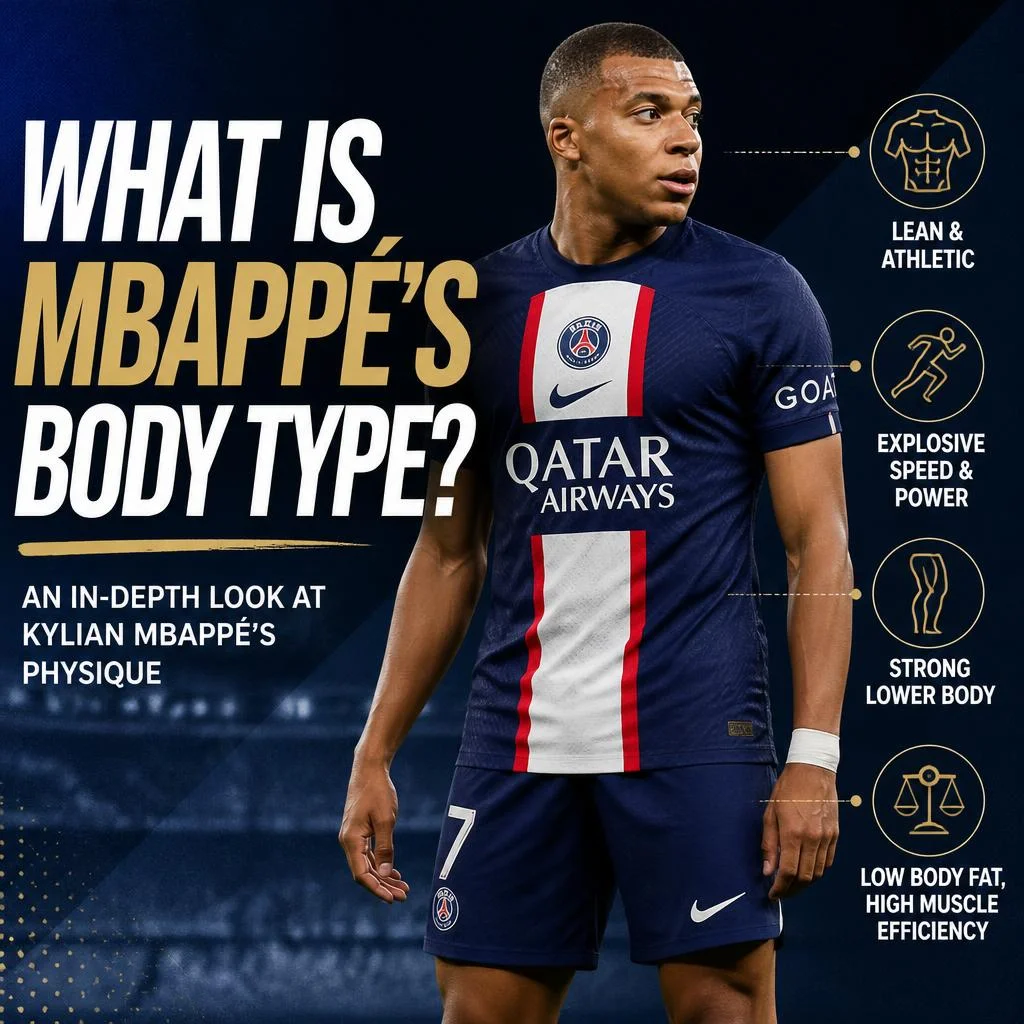
Mbappé has an athletic build that suits the physical demands of professional football. His playing style requires quick acceleration, repeated sprints, balance, agility, and the ability to change direction under pressure.
However, height and weight reveal only part of an athlete’s physical profile. Two people with identical measurements may have different muscle mass, endurance, strength, and coordination. Training history and individual body composition also influence how an athlete performs.
Speed and Acceleration
Speed stands out as one of Mbappé’s best-known qualities. A forward often needs to reach a loose ball, chase a through pass, or move beyond a defender in a short period. In these situations, explosive acceleration can provide a significant advantage.
Acceleration describes how quickly a player increases speed. By contrast, top speed refers to the fastest pace a player reaches during a run. Both qualities matter, although the best choice depends on the demands of a particular play.
Agility and Balance
Agility helps a footballer change direction without losing control. During a match, Mbappé may need to avoid a defender, adjust his running line, or react to an unexpected pass. Quick footwork and coordination help him respond to these situations.
Balance also matters because players frequently move at high speed while controlling the ball. Moreover, they must maintain their position when opponents challenge them physically. Good body control helps a player recover after contact and continue the movement.
Strength and Conditioning
Professional football demands more than speed. Players also need strength to compete for space, withstand contact, and repeat high-intensity actions throughout a match.
However, football conditioning does not focus solely on building large muscles. Instead, effective training supports power, mobility, endurance, coordination, and sport-specific movement. These qualities work together to help an athlete perform consistently.
How Does Mbappé’s Height Compare With Everyday Measurements?

Everyday comparisons help readers picture a height of 178 centimeters. The examples below use standard measurements, so they do not depend on estimates of Mbappé’s body proportions.
Compared With a Six-Foot Person
A person who measures exactly 6 feet tall has a height of 72 inches, or 182.88 centimeters. Mbappé’s listed height of 178 centimeters is about 4.88 centimeters shorter.
In inches, the difference is approximately 1.92 inches. Therefore, a six-foot person would stand just under two inches taller than Mbappé.
Compared With Someone Who Is Five Feet Nine Inches Tall
A height of 5 feet 9 inches equals 69 inches, or 175.26 centimeters. Mbappé’s listed height exceeds that figure by approximately 1.08 inches.
Consequently, the difference between these two heights is relatively small. This comparison also shows why rounding can make nearby heights appear almost identical.
Compared With Someone Who Is Five Feet Tall
A person who stands 5 feet tall measures 60 inches, or 152.4 centimeters. Compared with Mbappé’s listed height of approximately 70.08 inches, the difference is about 10.08 inches.
This comparison offers a simple way to visualize the gap between the two measurements.
Compared With an 80-Inch Doorway
Many standard interior doorways in the United States measure around 80 inches tall, although building designs vary. Compared with an 80-inch doorway, a height of 70.08 inches leaves a difference of approximately 9.92 inches.
Still, this example serves only as a general reference. Exterior doors, older buildings, and custom installations may use different dimensions.
How Do Mbappé’s Physical Qualities Support His Football?

Height and weight provide useful background information, but they cannot fully explain an athlete’s speed or success. Instead, performance depends on several qualities working together, including strength, coordination, technique, reaction time, and tactical awareness.
Explosive Movement
Explosive movement helps an attacker accelerate into space and reach the ball before a defender. It requires the athlete to produce force quickly while maintaining coordination.
Players must also slow down and change direction safely. Therefore, balance and body control matter alongside straight-line speed.
Ball Control at Speed
Fast running becomes more effective when a player can control the ball at the same time. A forward must judge the ball’s position, adjust each stride, and watch the movements of defenders.
Mbappé combines pace with dribbling ability, allowing him to attack open spaces and challenge defenders. His physical qualities support these technical skills rather than replace them.
Timing and Decision-Making
An effective attacking run does not always require maximum speed. Sometimes, a carefully timed movement creates more space than a full sprint. A forward must also recognize when to pass, shoot, or change direction.
As a result, football performance depends on both physical ability and smart decisions. These qualities help explain why height alone cannot determine how successful a player becomes.
Why Are Exact Chest, Waist, and Biceps Measurements Difficult to Confirm?

People often search for celebrity measurements such as chest size, waist circumference, and biceps size. However, official football profiles generally focus on basic player information rather than detailed body measurements.
Some celebrity-statistics websites publish these additional numbers without identifying a reliable source. Other websites may repeat figures from earlier articles, making an estimate appear more certain than the evidence supports.
For that reason, this guide does not assign exact chest, waist, biceps, shoe-size, or body-fat figures to Mbappé without credible evidence. Accuracy matters more than filling a table with unsupported numbers.
Instead, readers should distinguish confirmed statistics from estimates. If a reliable source publishes a specific measurement in the future, an article can include that number with clear attribution.
Frequently Asked Questions
How tall is Kylian Mbappé in feet and inches?
Mbappé’s listed height is 178 centimeters, which converts to approximately 5 feet 10 inches. The more precise result is about 5 feet 10.08 inches.
What is Kylian Mbappé’s height in centimeters?
His listed height is 178 centimeters, equivalent to 1.78 meters or approximately 70.08 inches.
What is Kylian Mbappé’s weight in pounds?
Real Madrid lists his weight as 75 kilograms, or approximately 165.3 pounds. UEFA lists 67 kilograms, or approximately 147.7 pounds. Because the sources differ, readers should identify which profile they use.
What are Kylian Mbappé’s exact body measurements?
His height is widely listed as 178 centimeters. However, reliable official sources do not consistently provide exact chest, waist, or biceps measurements. Readers should avoid treating unsupported numbers as confirmed facts.
Is Mbappé six feet tall?
No. His listed height is 178 centimeters, or approximately 5 feet 10 inches. A person who measures six feet tall stands 182.88 centimeters, about 4.88 centimeters taller than Mbappé.
Is Mbappé considered tall for a footballer?
At approximately 5 feet 10 inches, Mbappé is not exceptionally tall for a professional footballer. Players succeed at many different heights because technical ability, physical conditioning, and tactical awareness all contribute to performance.
Does Mbappé’s height make him faster?
No single height guarantees speed. Acceleration, strength, coordination, running technique, and training all affect sprinting performance. Mbappé’s pace reflects a combination of athletic qualities rather than height alone.
What position does Kylian Mbappé play?
Mbappé plays as a forward. He is known for his attacking runs, speed, dribbling, and goal-scoring ability. His specific role can change depending on his team’s formation and tactics.
Are online celebrity body measurements always accurate?
No. Some websites publish estimates without providing reliable evidence. Official football profiles generally offer a better starting point for height and weight than unsourced claims about chest, waist, or biceps size.
Conclusion
Kylian Mbappé’s listed height is 178 centimeters, or approximately 5 feet 10 inches. His weight varies between published football profiles: Real Madrid lists 75 kilograms, while UEFA lists 67 kilograms. These figures convert to approximately 165.3 pounds and 147.7 pounds, respectively.
His athletic build supports the demands of professional football, including acceleration, agility, balance, and repeated high-intensity movement. Nevertheless, measurements alone cannot explain his success. Technical skill, tactical awareness, conditioning, and decision-making also contribute to his performance.
For readers researching Kylian Mbappé body measurements, the best approach is to use documented statistics, explain differences between sources, and avoid unsupported claims about chest, waist, or biceps size. This approach provides a more accurate and useful guide for fans interested in his height, weight, and athletic profile.

Lucas Morgan is a passionate writer who enjoys creating helpful, engaging, and practical content for readers. He focuses on sharing clear ideas, useful insights, and creative inspiration through every article.