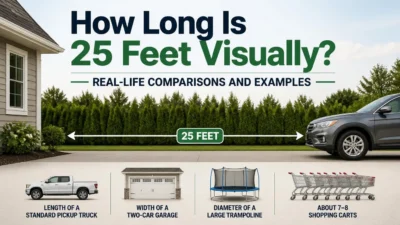

Fifty feet is a useful length to understand when measuring a backyard, planning a home project, estimating a building’s dimensions, or figuring out the distance between two objects. However, imagining a measurement in feet can be difficult when you do not have a measuring tape nearby.
So, how long is 50 feet? 50 feet equals 600 inches, 15.24 meters, 1,524 centimeters, or approximately 16.67 yards. It is about half the length of a 100-foot football field segment and roughly the length of five cars parked end to end, assuming each car measures around 10 feet.
This guide explains how long 50 feet looks in real life, compares it with familiar objects and sports facilities, and provides simple conversion charts to help you visualize the distance.
How Long Is 50 Feet in Inches, Meters, and Other Units?
The easiest way to understand this measurement is to convert it into units you already know. Feet and inches are common in the United States, while meters and centimeters help people compare measurements using the metric system.
Here is a quick breakdown of 50 feet.
| Unit | Equivalent measurement |
|---|---|
| Feet | 50 ft |
| Inches | 600 in |
| Yards | 16.67 yd |
| Meters | 15.24 m |
| Centimeters | 1,524 cm |
| Millimeters | 15,240 mm |
| Kilometers | 0.01524 km |
| Miles | Approximately 0.00947 mi |
These conversions use standard measurement relationships. One foot contains 12 inches, and one yard contains 3 feet. A foot also equals exactly 0.3048 meters.
For example, multiplying 50 by 12 gives 600 inches. Similarly, multiplying 50 by 0.3048 gives 15.24 meters.
For most everyday projects, you can remember one simple figure: 50 feet is just over 15 meters long.
How Long Is 50 Feet Visually?

Imagine standing at one end of a 50-foot stretch of pavement and looking toward the other end. The distance would cover more ground than many living rooms or residential driveways, yet it would remain short enough to walk in several seconds at a normal pace.
The easiest way to picture it is to compare the distance with objects you see every day.
For instance, five cars measuring approximately 10 feet each would span about 50 feet when parked bumper to bumper. A typical school bus may also approach this length, although bus sizes vary considerably. Meanwhile, a 50-foot measurement covers about two-thirds of a standard tennis court’s playing length.
These examples are estimates rather than exact substitutes for a measuring tape. Still, they provide a practical mental picture of the distance.
Is 50 Feet a Long Distance?
Whether 50 feet feels long depends on the situation. Across a large room or a small backyard, it can seem substantial. On a football field or a large parking lot, the same distance may look relatively short.
For a home project, 50 feet could cover a long fence section, a garden bed, or part of a driveway. Indoors, it would extend much farther than most individual rooms.
Walking 50 feet usually takes around 10 to 20 seconds for many adults, depending on walking speed and obstacles. That estimate helps visualize the distance, but walking time does not provide an exact measurement.
7 Real-Life Comparisons That Help You Picture 50 Feet

Familiar objects can turn an abstract number into something you can picture. The following comparisons use approximate dimensions, so the actual length may differ depending on the object.
1. Five Cars Parked End to End

<AsyncImage query=”five ordinary passenger cars parked in a straight line side view parking lot” aspectRatio=”16:9″ width=”100%” />
Many passenger cars measure approximately 12 to 16 feet long, although compact models can be shorter. A group of five cars could therefore cover roughly 60 to 80 feet.
For a closer 50-foot comparison, imagine five compact vehicles measuring about 10 feet each. Their combined length would equal 50 feet.
This is a useful mental reference in a parking lot, but remember that real vehicles vary in size. If you need an accurate measurement for a driveway or parking area, check the dimensions of the vehicles involved.
2. A Long Residential Driveway

<AsyncImage query=”long residential driveway leading from house to street suburban American home” aspectRatio=”16:9″ width=”100%” />
A 50-foot driveway section can provide a helpful example of the distance. Picture a straight path extending from a garage toward the street or across part of a front yard.
Some driveways are shorter, while others extend well beyond 50 feet. Their size depends on the property, garage location, parking requirements, and local layout.
If you are planning a driveway, fence, or landscaping project, marking two points 50 feet apart with a tape measure will give you a more dependable reference than estimating from a photograph.
3. About Two-Thirds of a Tennis Court’s Length

<AsyncImage query=”standard tennis court full court overhead view with baseline and net visible” aspectRatio=”16:9″ width=”100%” />
A standard tennis court measures 78 feet from one baseline to the other. A 50-foot length therefore covers approximately 64 percent of the court’s playing length.
To calculate the comparison, divide 50 by 78 and multiply by 100. The result is about 64.1 percent.
This is a useful example because tennis courts have standardized dimensions. However, the 50-foot distance represents a portion of the court’s length, not its width.
4. A School Bus, Depending on Its Size

<AsyncImage query=”yellow American school bus parked side view full length” aspectRatio=”16:9″ width=”100%” />
School buses come in different sizes, so no single bus length represents exactly 50 feet. Many full-size school buses measure around 35 to 45 feet, while some configurations may approach or exceed that range.
A 50-foot line would be somewhat longer than many familiar full-size school buses. This makes a school bus a helpful visual reference, provided you remember that its dimensions vary by model.
For a more exact comparison, use the manufacturer’s published dimensions for a specific bus rather than relying on its appearance.
5. A 50-Foot Garden or Fence Section

<AsyncImage query=”long straight backyard wooden fence along garden lawn residential property” aspectRatio=”16:9″ width=”100%” />
Fifty feet is a practical length for imagining a garden border, fence run, or landscaped section of a yard.
For example, a straight fence section measuring 50 feet would extend 600 inches from one end to the other. If you planned to install fencing in 8-foot sections, six full sections would cover 48 feet, leaving another 2 feet to reach the target length.
Real fence layouts may require different panel sizes, posts, and spacing. Always measure the property before buying materials.
6. Five 10-Foot Sections of Rope

<AsyncImage query=”measuring tape stretched along long rope on outdoor grass” aspectRatio=”16:9″ width=”100%” />
A simple way to visualize 50 feet is to divide it into five equal sections. Each section would measure 10 feet, and all five together would create a 50-foot line.
This approach works well for ropes, cables, garden hoses, outdoor lighting, and temporary boundaries. It also makes the measurement easier to estimate when you do not have one continuous 50-foot measuring tape.
If accuracy matters, mark each 10-foot section carefully and check the total length before using the material.
7. A Large Room or Event Space
<AsyncImage query=”large empty American community hall event space wide interior floor” aspectRatio=”16:9″ width=”100%” />
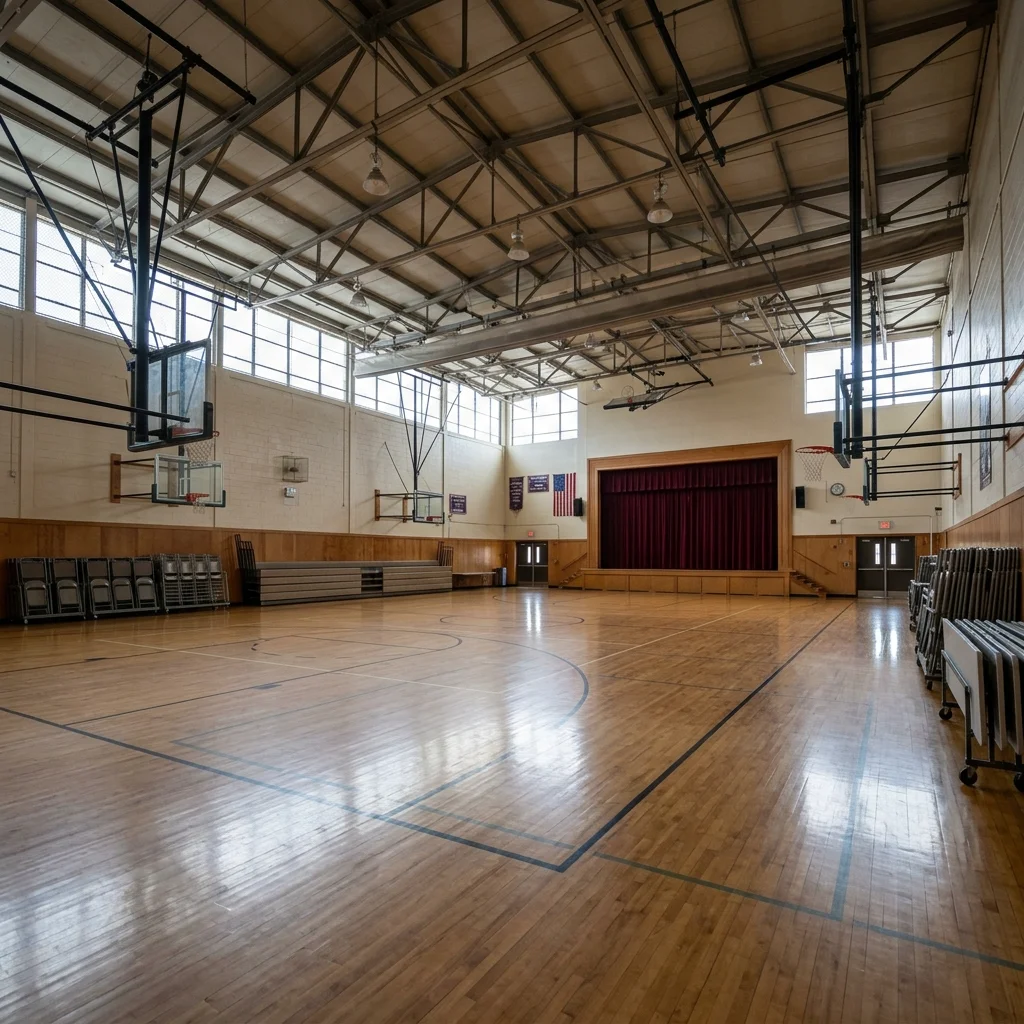
A 50-foot span is longer than many individual rooms in a typical home. In a large community hall, gymnasium, or event venue, however, it may represent only part of the available floor space.
Imagine stretching a measuring tape from one side of a room to a point 50 feet away. That comparison can help when planning seating, temporary displays, or room layouts.
For events, measure the usable floor area rather than the building’s exterior dimensions. Columns, furniture, walls, and access routes can reduce the available space.
How Many Inches Are in 50 Feet?

There are 600 inches in 50 feet. This conversion is straightforward because every foot contains 12 inches.
The calculation looks like this:
50 × 12 = 600 inches.
This number becomes useful when you need a more detailed measurement for a small project or when a product lists its dimensions in inches.
For example, suppose you need a cable that stretches 50 feet. Its length in inches would be 600 inches. If you wanted to divide the cable into six equal pieces, each piece would measure 100 inches, or 8 feet 4 inches.
Quick Feet-to-Inches Chart
| Feet | Inches |
|---|---|
| 5 ft | 60 in |
| 10 ft | 120 in |
| 15 ft | 180 in |
| 20 ft | 240 in |
| 25 ft | 300 in |
| 30 ft | 360 in |
| 40 ft | 480 in |
| 50 ft | 600 in |
This chart provides a quick reference for common lengths. To convert any other measurement in feet into inches, simply multiply the number of feet by 12.
How Many Meters Is 50 Feet?
Fifty feet equals 15.24 meters. This is the exact metric conversion, not an estimate.
The conversion works because one foot equals 0.3048 meters. Therefore:
50 × 0.3048 = 15.24 meters.
If you prefer centimeters, multiply the meter value by 100. That gives 1,524 centimeters.
Feet-to-Meters Conversion Chart
| Feet | Meters |
|---|---|
| 5 ft | 1.524 m |
| 10 ft | 3.048 m |
| 15 ft | 4.572 m |
| 20 ft | 6.096 m |
| 25 ft | 7.62 m |
| 30 ft | 9.144 m |
| 40 ft | 12.192 m |
| 50 ft | 15.24 m |
These values can help with international measurements, construction planning, landscaping, and equipment specifications.
If you only need a rough visual estimate, you can round 15.24 meters to about 15 meters. For cutting materials or planning precise layouts, use the full value.
How Long Does It Take to Walk 50 Feet?

Walking 50 feet does not take very long for most adults. At a moderate pace, many people cover this distance in roughly 10 to 20 seconds.
Your walking speed depends on several factors, including your stride length, pace, footwear, terrain, and whether you need to stop or turn.
For a simple estimate, consider a walking speed of 3 miles per hour. That equals 4.4 feet per second. At that speed, a 50-foot walk takes about 11.4 seconds.
This gives you a practical way to picture the distance. However, walking time should not replace a proper measurement when accuracy matters.
Where Might You Use a 50-Foot Measurement?

A 50-foot length appears in many household, outdoor, and commercial projects. Knowing the equivalent measurements can help you plan materials and avoid purchasing the wrong amount.
Landscaping and Gardening
A 50-foot distance may represent a fence line, a row of plants, a garden border, or a section of lawn. Converting the length into meters can also help when you purchase materials from a supplier that uses metric units.
Before buying edging, fencing, or irrigation supplies, measure the full route. Curved boundaries and corners may require more material than a straight-line estimate suggests.
Electrical Cables and Extension Cords
Some extension cords and cables come in 50-foot lengths. That size can be useful when a power source sits a considerable distance from the equipment.
However, the correct cable depends on its intended use, electrical rating, and safety requirements. Do not choose an electrical cord based on length alone.
Construction and Home Improvement
Contractors and homeowners may use a 50-foot measurement for layout work, fencing, material estimates, and outdoor planning.
A long tape measure can help mark the distance accurately. For larger projects, survey equipment or laser measuring tools may provide additional precision, depending on the site and the required tolerance.
Event Planning
A 50-foot span can help organizers plan queue lines, seating layouts, decorative installations, and temporary barriers. Converting the measurement into inches or meters can also make coordination easier when different suppliers use different units.
Always account for walking paths, emergency exits, and accessibility when arranging an event space.
Is 50 Feet the Same as 50 Yards?

No. Feet and yards are different units of length.
One yard equals 3 feet, so 50 yards equals 150 feet. By comparison, 50 feet equals approximately 16.67 yards.
This means 50 yards is three times as long as 50 feet.
The distinction matters when reading sports-field measurements, fabric lengths, landscaping plans, or product descriptions. If a project specifies 50 feet, ordering 50 yards would provide three times the required length.
Frequently Asked Questions
How long is 50 feet in inches?
Fifty feet equals 600 inches. Multiply 50 by 12 because each foot contains 12 inches.
How long is 50 feet in meters?
Fifty feet equals exactly 15.24 meters. For a quick estimate, you can round it to about 15 meters.
How many yards are in 50 feet?
Fifty feet equals approximately 16.67 yards. Divide 50 by 3 to convert feet into yards.
Is 50 feet longer than a school bus?
Fifty feet is longer than many full-size school buses, which often measure around 35 to 45 feet. However, bus lengths vary by model, so check the specifications for an exact comparison.
How many cars fit into 50 feet?
Five compact cars measuring approximately 10 feet each would cover 50 feet when parked end to end. Many passenger cars are longer than 10 feet, so five typical cars may extend beyond that distance.
How long does it take to walk 50 feet?
Many adults can walk 50 feet in approximately 10 to 20 seconds. The exact time depends on walking speed, stride length, and the surrounding conditions.
Is 50 feet a good length for a backyard fence?
It can be suitable for a short fence run or part of a yard boundary. Whether it is enough depends on your property layout and the area you want to enclose.
How do I measure 50 feet without a tape measure?
You can estimate the distance using familiar objects, such as vehicle lengths, or by marking several shorter sections. For accurate results, borrow or purchase a long measuring tape instead of relying on visual estimates.
Conclusion
Fifty feet equals 600 inches, 16.67 yards, or 15.24 meters. Although the number may seem abstract, comparisons with cars, school buses, tennis courts, driveways, and garden fences make the distance easier to picture.
For a quick mental image, think of a straight line measuring just over 15 meters or five sections of 10 feet each. These references work well for everyday estimates, home projects, and general measurement questions.
When precision matters, however, use a measuring tape or another suitable tool. Real-life comparisons provide context, but an actual measurement remains the most reliable way to confirm a 50-foot distance.

Lucas Morgan is a passionate writer who enjoys creating helpful, engaging, and practical content for readers. He focuses on sharing clear ideas, useful insights, and creative inspiration through every article.