

A US dollar bill is one of the most recognizable pieces of paper currency in the world. Although people use cash every day, many do not know its exact length, width, or thickness. These measurements can be useful when comparing everyday objects, designing wallets, creating educational projects, or learning about US currency.
A standard US dollar bill measures 6.14 inches long and 2.61 inches wide. That equals approximately 15.6 centimeters in length and 6.63 centimeters in width. The standard dimensions apply to current US paper currency, including the $1, $2, $5, $10, $20, $50, and $100 bills. The US Currency Education Program confirms that these denominations share the same standard size.
This guide explains the exact measurements, unit conversions, thickness, surface area, everyday comparisons, and historical background of American paper money.
Dollar Bill Dimensions at a Glance
US paper currency follows a standardized size, so a $1 bill has the same basic dimensions as a $100 bill. The denomination changes the printed design and monetary value, but not the overall size of the note.
| Measurement | Exact or approximate size |
|---|---|
| Length | 6.14 inches |
| Width | 2.61 inches |
| Length in centimeters | 15.60 cm |
| Width in centimeters | 6.63 cm |
| Length in millimeters | 155.96 mm |
| Width in millimeters | 66.29 mm |
| Length in feet | 0.512 ft |
| Width in feet | 0.218 ft |
| Length in meters | 0.156 m |
| Width in meters | 0.0663 m |
| Surface area | 16.03 square inches |
The US Currency Education Program lists the standard dimensions as 6.14 by 2.61 inches. These figures describe the face of a single bill, measured from one edge to the opposite edge.
Keep in mind that a used bill may have wrinkles, folded corners, or damaged edges. Those conditions can affect its apparent size, but they do not change the standard dimensions used for US currency.
How Long Is a Dollar Bill?

A standard US dollar bill measures 6.14 inches long, or approximately 15.6 centimeters. The length runs from the left edge to the right edge when you hold the bill horizontally with the printed portrait facing you.
This measurement provides a convenient reference for everyday comparisons. For example, a dollar bill is slightly longer than a standard 6-inch ruler. It is also longer than many credit cards, which measure approximately 3.37 inches long.
The extra length gives the bill enough space for its portrait, serial numbers, seals, decorative borders, and other printed details.
Dollar Bill Length in Different Units
Here are the most useful conversions for a 6.14-inch bill.
- Inches: 6.14 inches
- Centimeters: 15.5956 cm
- Millimeters: 155.956 mm
- Feet: approximately 0.5117 feet
- Meters: 0.155956 meters
For everyday use, you can round these figures to 15.6 cm, 156 mm, or 0.156 meters.
The conversions follow a simple rule: one inch equals 2.54 centimeters. Multiplying 6.14 by 2.54 gives 15.5956 centimeters. Rounding to two decimal places produces 15.60 cm.
Is a Dollar Bill Longer Than a Credit Card?
Yes. A standard US dollar bill measures 6.14 inches long, while a typical credit card measures approximately 3.37 inches long.
That makes the bill about 2.77 inches longer than the card. In other words, the bill measures roughly 1.82 times the card’s length.
This comparison also explains why folded cash fits more easily into compact wallets. An unfolded bill needs considerably more horizontal space than a payment card.
How Wide Is a Dollar Bill?

A standard dollar bill measures 2.61 inches wide, equivalent to approximately 6.63 centimeters. This measurement runs from the top edge to the bottom edge when the bill lies horizontally.
Although the bill is relatively long, its narrow shape makes it easy to fold and store. The width also allows the currency designers to arrange the portrait, denomination, seals, and decorative patterns within a consistent rectangular format.
Dollar Bill Width in Different Units
The standard width converts into the following measurements:
- Inches: 2.61 inches
- Centimeters: 6.6294 cm
- Millimeters: 66.294 mm
- Feet: approximately 0.2175 feet
- Meters: 0.066294 meters
For quick calculations, use 6.63 cm or 66.3 mm.
Is a Dollar Bill Wider Than a Credit Card?
Yes. A typical credit card measures about 2.125 inches wide, while a dollar bill measures 2.61 inches wide.
The difference is approximately 0.485 inches, or 1.23 centimeters. Therefore, a dollar bill is noticeably wider than a standard credit card.
This difference matters when comparing wallet compartments. Card slots generally accommodate the narrower shape of a credit card, while cash compartments need enough room for the larger dimensions of paper currency.
How Thick Is a Dollar Bill?

The thickness of a dollar bill is much smaller than its length or width. A commonly cited technical measurement for US currency is approximately 0.0043 inches thick, although actual thickness can vary slightly with manufacturing tolerances, wear, and moisture.
This equals approximately 0.109 millimeters. Because the material is thin and flexible, measuring a single bill accurately requires a sensitive instrument rather than an ordinary ruler.
Thickness also helps explain why a stack of bills can fit into a relatively small space. Each note adds only a tiny amount to the overall height of the stack.
How Thick Is a Stack of Dollar Bills?
Using 0.0043 inches as an approximate thickness for each bill, you can estimate the height of a stack by multiplying the number of bills by the thickness of one note.
| Number of bills | Estimated stack thickness |
|---|---|
| 1 bill | 0.0043 inches |
| 10 bills | 0.043 inches |
| 20 bills | 0.086 inches |
| 50 bills | 0.215 inches |
| 100 bills | 0.43 inches |
| 500 bills | 2.15 inches |
| 1,000 bills | 4.3 inches |
These are estimates, not guaranteed measurements. Real stacks can differ because bills have varying wear, folds, and moisture levels. Pressing the stack together can also change its measured thickness.
A stack of 100 relatively flat bills would measure about 0.43 inches thick using this estimate. That is less than half an inch, which helps explain how banks and cash handlers store large quantities of currency in compact bundles.
Dollar Bill Dimensions in Centimeters and Millimeters
Many people outside the United States use the metric system for everyday measurements. Converting dollar bill dimensions into centimeters and millimeters makes comparisons easier.
The standard length of 6.14 inches equals 15.5956 cm. Meanwhile, the standard width of 2.61 inches equals 6.6294 cm.
For most practical purposes, you can use 15.6 cm long by 6.63 cm wide.
Conversion Table
| Unit | Length | Width |
|---|---|---|
| Inches | 6.14 in | 2.61 in |
| Centimeters | 15.60 cm | 6.63 cm |
| Millimeters | 155.96 mm | 66.29 mm |
| Feet | 0.5117 ft | 0.2175 ft |
| Meters | 0.1560 m | 0.0663 m |
These values use the standard inch-to-metric conversion. Small differences in the last decimal place may appear when a calculator rounds the result differently.
For a school assignment or craft project, the rounded metric dimensions should usually provide enough precision. However, a design that requires exact manufacturing tolerances should use the appropriate technical specifications.
Dollar Bill Surface Area and Perimeter

The length and width also allow you to calculate the surface area and perimeter of a dollar bill. These calculations help describe the overall size of the rectangular note.
Surface Area
To calculate the surface area of a rectangle, multiply its length by its width.
For a standard dollar bill:
6.14 × 2.61 = 16.0254 square inches.
Therefore, the bill has a surface area of approximately 16.03 square inches.
In metric units, the same area is approximately 103.3 square centimeters.
This figure describes one flat face of the bill. Both faces together have a combined printed surface area of approximately 32.05 square inches, although that does not change the physical footprint of the note.
Perimeter
The perimeter measures the total distance around the outside edge of the bill. To calculate it, add the length and width, then multiply the result by two.
(6.14 + 2.61) × 2 = 17.5 inches.
Therefore, the perimeter of a standard dollar bill is approximately 17.5 inches, or 44.45 centimeters.
These calculations assume a rectangular shape with the standard dimensions. A torn, curled, or damaged note may not follow that ideal outline perfectly.
What Does a Dollar Bill Look Like Compared With Everyday Objects?

Measurements become easier to understand when you compare them with familiar objects. A dollar bill is small enough to fit into a wallet, yet its length and width make it larger than several common cards and compact items.
Dollar Bill vs. Credit Card

<text color=”secondary” size=”sm”>Typical credit card: approximately 3.37 × 2.125 inches.</text>
A dollar bill is substantially longer and slightly wider than a standard credit card. The bill measures 6.14 inches long, compared with about 3.37 inches for the card.
Consequently, a dollar bill needs a longer storage space. A card can fit into a narrow slot, while cash usually requires a wider wallet compartment or a fold.
Dollar Bill vs. 6-Inch Ruler
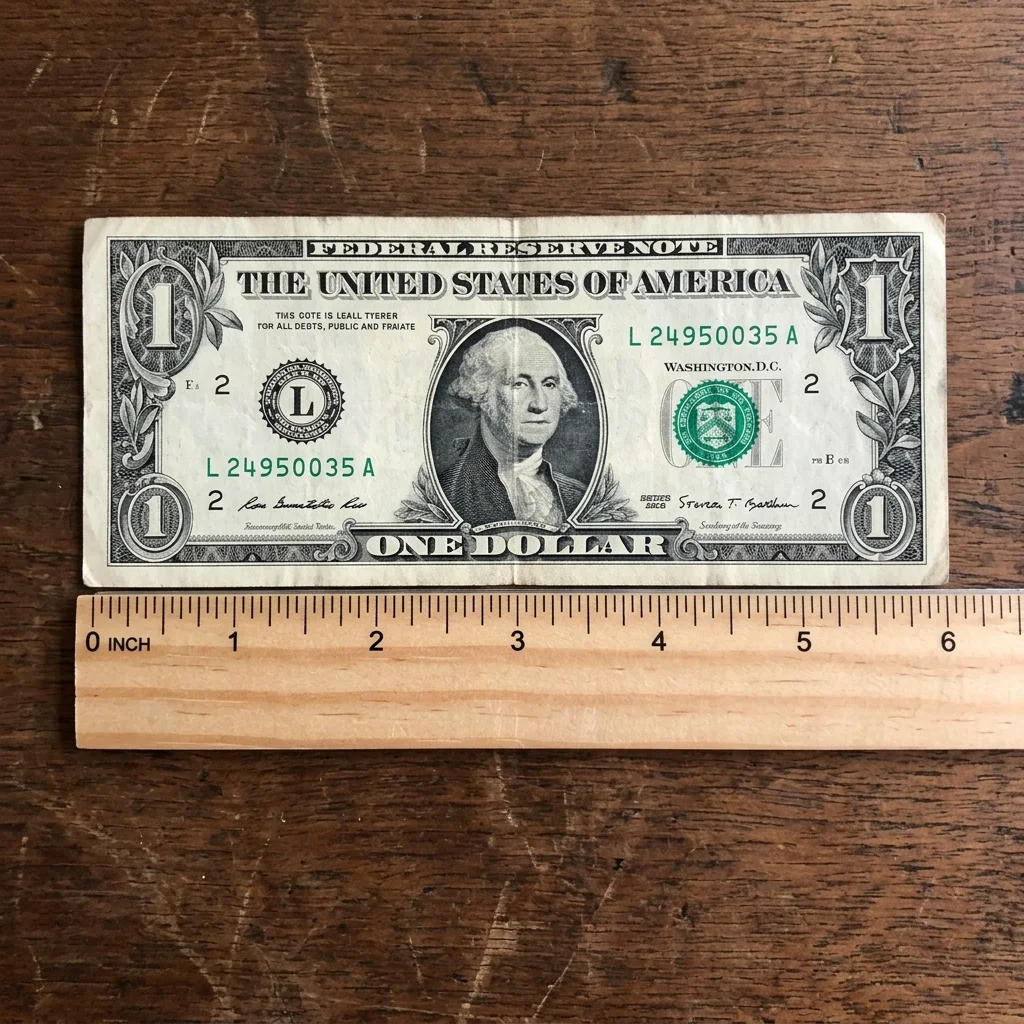
A dollar bill is just 0.14 inches longer than a ruler that measures exactly 6 inches. This makes a 6-inch ruler a useful reference for estimating the length of paper currency.
However, the ruler comparison only helps with length. A dollar bill has a width of 2.61 inches, so it is much broader than the thin measuring strip of a ruler.
Dollar Bill vs. Smartphone

Most smartphones have a greater length than a dollar bill, although exact dimensions depend on the model. A phone measuring 6.5 inches tall, for example, would be 0.36 inches longer than a standard dollar bill.
Smartphones also tend to be much thicker and heavier. Therefore, a dollar bill provides a useful comparison for length but not for overall volume or weight.
Dollar Bill vs. Index Card

A common 3 × 5-inch index card is shorter and slightly wider than a dollar bill. The bill measures 6.14 inches long, so it extends 1.14 inches beyond the card’s 5-inch side.
At the same time, the bill’s 2.61-inch width is a little narrower than the card’s 3-inch side. This comparison illustrates the bill’s long, narrow rectangular shape.
Dollar Bill vs. Business Card

A typical US business card measures 3.5 × 2 inches. Compared with that size, a dollar bill is 2.64 inches longer and 0.61 inches wider.
A bill therefore occupies considerably more space than a standard business card. This distinction can be useful when designing printed materials or estimating the size of small storage compartments.
Are All US Dollar Bills the Same Size?

Yes. Modern US paper currency uses a standard size across the seven denominations currently issued: $1, $2, $5, $10, $20, $50, and $100.
This means a $1 bill and a $100 bill share the same nominal length and width. The printed portraits, colors, security features, and monetary values differ, but the overall dimensions remain consistent.
Standardization makes currency easier to handle, count, transport, and store. Cash registers, currency counters, wallets, and other money-handling equipment can accommodate the same basic note size regardless of denomination.
The standard size also makes comparisons straightforward. You do not need a different measurement chart for each currently issued denomination.
Does a $100 Bill Have Larger Dimensions Than a $1 Bill?
No. A standard $100 bill does not measure more than a standard $1 bill. Both have the same nominal dimensions of 6.14 × 2.61 inches.
The $100 bill carries a higher monetary value, but its size remains consistent with other current US paper notes.
This differs from some currencies around the world, where denominations may use different physical sizes. US currency relies on other design and security features to distinguish denominations.
Why Are US Dollar Bills This Size?

The current size of US currency dates to the standardization introduced in 1929. Before that change, US banknotes were larger. The US Currency Education Program explains that the earlier notes measured 7.375 × 3.125 inches, compared with the modern standard of 6.14 × 2.61 inches.
The change reduced the size of the notes by about 30 percent and helped standardize designs across denominations.
Smaller notes require less material and are easier to handle and store. Standard dimensions also support efficient production and simplify the work of businesses and financial institutions that process large quantities of cash.
Although the designs of US currency have changed over time to incorporate updated security features, the familiar overall dimensions have remained consistent.
How to Measure a Dollar Bill at Home

You can check the size of a dollar bill with a ruler, measuring tape, or digital caliper. A ruler works well for basic measurements, while a caliper can provide more precise readings.
Follow these steps for a simple measurement:
- Place the bill on a flat, clean surface.
- Smooth out folds gently without damaging the note.
- Align the zero mark of your ruler with one short edge.
- Measure the full length from one end to the other.
- Turn your attention to the short dimension and measure the width.
- Record the results in inches or centimeters.
A standard bill should measure close to 6.14 inches long and 2.61 inches wide. A worn note may not lie completely flat, so small variations can occur during a casual measurement.
Avoid using scissors, pins, or other tools that could damage the currency. You do not need to cut, stretch, or otherwise alter the bill to determine its size.
Frequently Asked Questions
What are the exact dimensions of a US dollar bill?
A standard US dollar bill measures 6.14 inches long and 2.61 inches wide. In metric units, that equals approximately 15.6 × 6.63 cm.
How long is a dollar bill in centimeters?
A dollar bill measures approximately 15.60 centimeters long. The conversion from 6.14 inches gives 15.5956 centimeters before rounding.
How wide is a dollar bill in inches?
The standard width is 2.61 inches, which equals approximately 6.63 centimeters.
How thick is a US dollar bill?
A commonly cited technical estimate is approximately 0.0043 inches, or 0.109 millimeters. Actual measurements can vary slightly depending on the note’s condition and manufacturing tolerances.
Are $1, $5, $10, and $100 bills the same size?
Yes. All seven currently issued US paper denominations use the same standard dimensions. The $1, $2, $5, $10, $20, $50, and $100 bills share the same nominal length and width.
How many inches long is a dollar bill?
A standard dollar bill is 6.14 inches long. This measurement is slightly greater than the length of a 6-inch ruler.
What is the area of a dollar bill?
Multiplying 6.14 inches by 2.61 inches gives approximately 16.03 square inches for one face of the bill.
How much larger were old US dollar bills?
Before the standardization introduced in 1929, US banknotes measured approximately 7.375 × 3.125 inches. The modern standard is 6.14 × 2.61 inches, making current notes noticeably smaller.
Can I use a dollar bill as a measuring tool?
Yes. A dollar bill can provide a rough reference for measuring small objects because its standard dimensions are known. However, use a ruler or measuring tape when accuracy matters, especially if the bill has folds or damaged edges.
Conclusion
The standard dimensions of a US dollar bill are 6.14 inches long and 2.61 inches wide, or approximately 15.6 × 6.63 centimeters. A commonly cited thickness estimate is 0.0043 inches, although actual thickness may vary slightly.
These measurements apply to the currently issued $1, $2, $5, $10, $20, $50, and $100 notes. The standardized size makes American currency easy to handle, count, store, and compare with everyday objects.
Whether you need the dimensions for a school project, a craft, a wallet design, or simple curiosity, knowing the length, width, and metric conversions gives you a practical understanding of the familiar US dollar bill.

Lucas Morgan is a passionate writer who enjoys creating helpful, engaging, and practical content for readers. He focuses on sharing clear ideas, useful insights, and creative inspiration through every article.