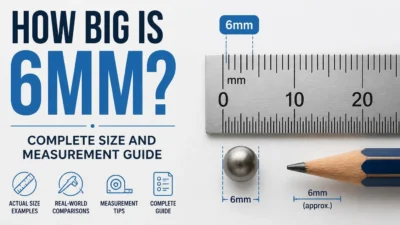

If you’re trying to understand how long is 7 inches, the easiest answer is that this length equals 17.78 centimeters (cm) or 177.8 millimeters (mm). It is also approximately 0.58 feet or 0.1778 meters.
While the conversion is simple, a number such as 7 inches can be difficult to visualize. Knowing the metric equivalent and comparing the length with familiar objects makes it much easier to understand.
In this guide, we’ll look at the exact conversion, visual comparisons, everyday examples, and simple ways to measure a 7-inch length.
7-Inch Measurement at a Glance
Here are the most useful conversions:
| Unit | Equivalent |
|---|---|
| Inches | 7 inches |
| Centimeters | 17.78 cm |
| Millimeters | 177.8 mm |
| Feet | 0.5833 ft |
| Yards | 0.1944 yd |
| Meters | 0.1778 m |
For everyday use, you can round 17.78 cm to approximately 18 cm.
Converting Inches to Centimeters

The easiest way to convert inches into centimeters is to multiply the number of inches by 2.54.
For seven inches:
7 × 2.54 = 17.78 cm
Therefore, the exact metric equivalent is 17.78 centimeters.
This conversion is useful when product specifications are listed in inches but you’re more familiar with centimeters. For a quick estimate, 7 inches can simply be remembered as about 18 cm.
The Measurement in Millimeters
Millimeters provide a more precise way to describe smaller lengths.
Since one inch equals 25.4 mm:
7 × 25.4 = 177.8 mm
So, the length is exactly 177.8 millimeters, or approximately 178 mm when rounded to the nearest whole millimeter.
This unit can be particularly useful for crafts, tools, hardware, electronics, and other items where small differences matter.
Converting the Length to Feet

A standard foot contains 12 inches. To convert this measurement into feet:
7 ÷ 12 = 0.5833 feet
So, 7 inches is approximately 0.58 feet.
It is worth remembering that this is more than half a foot because half of 12 inches is 6 inches. The remaining inch makes the measurement slightly longer than half a foot.
Conversion to Meters
For metric measurements involving larger units, you can convert the length into meters.
One inch equals 0.0254 meters, so:
7 × 0.0254 = 0.1778 meters
Therefore, the equivalent is 0.1778 meters, which can be rounded to 0.18 meters.
What Does 7 Inches Look Like?
A measurement is often easier to understand when you can compare it with something familiar.
Seven inches is approximately 17.8 cm long. It is a little longer than half a foot and noticeably shorter than a full 12-inch ruler.
Depending on the object, this length can be considered fairly small. For a phone, book, craft project, or household item, however, seven inches can be a noticeable size.
Remember that comparisons with everyday objects are only approximate. If accuracy matters, use an actual measuring tool.
Everyday Objects Around This Size
Several common objects can help you visualize a length of approximately 7 inches.
Small Rulers

Some compact rulers measure around 6 to 7 inches. If you have one, it provides a useful physical reference for this measurement.
A standard 12-inch ruler can also show the size clearly: simply look at the distance between the 0-inch and 7-inch marks.
Smartphones

Some larger smartphones may have an overall length approaching this measurement. However, phone dimensions vary by model, so a smartphone should only be used as a rough visual comparison.
Also, don’t confuse a phone’s overall length with its screen size. Screen sizes are usually measured diagonally.
Small Books

Some paperback books and notebooks can have a width close to seven inches. Book sizes vary considerably, so this should be treated as an approximate comparison rather than an exact one.
Household Items

Small picture frames, kitchen utensils, craft supplies, stationery products, and other household objects can also have dimensions close to this length.
These examples help show that 7 inches is approximately the length of a relatively small everyday object.
Comparing 6, 7, and 8 Inches
Looking at nearby measurements can make the difference easier to understand.
| Length | Centimeters | Difference From 7 Inches |
|---|---|---|
| 6 inches | 15.24 cm | 1 inch shorter |
| 7 inches | 17.78 cm | — |
| 8 inches | 20.32 cm | 1 inch longer |
| 9 inches | 22.86 cm | 2 inches longer |
| 10 inches | 25.40 cm | 3 inches longer |
| 12 inches | 30.48 cm | 5 inches longer |
The difference between each neighboring measurement is 2.54 cm, because one inch equals 2.54 cm.
Is Seven Inches More Than Half a Foot?
Yes.
A foot contains 12 inches, and half of 12 is 6. Therefore, seven inches is one inch longer than half a foot.
In percentage terms:
7 ÷ 12 × 100 = 58.33%
So this length represents approximately 58.3% of a foot.
How It Compares With a Full Foot

A full foot is 12 inches, while this measurement is 7 inches.
The difference is:
12 − 7 = 5 inches
That means a 7-inch object is exactly 5 inches shorter than one foot.
In centimeters, a foot is 30.48 cm, while seven inches is 17.78 cm.
This gives you another useful reference when estimating the size of an object.
Measuring Seven Inches With a Ruler
The most accurate way to measure this length is with a ruler.
Place the beginning of the object at the 0-inch mark, then extend the ruler along its length until the other end reaches the 7-inch mark.
If the object reaches the 7-inch line, its length is exactly seven inches.
When using a ruler, make sure the object starts at the correct zero point. Some rulers have a small space before the first measurement marking, so using the physical edge instead of the zero mark can result in an inaccurate measurement.
Measuring Without a Ruler

If you don’t have a ruler, you can estimate the length using familiar objects.
For example, the short side of standard U.S. letter paper is 8.5 inches, making seven inches about 1.5 inches shorter.
You can also use a known-size object as a reference. However, these methods are suitable only for rough estimates.
For precise measurements, a ruler, measuring tape, or another calibrated measuring tool is recommended.
Using Your Hand as a Reference
Your hand can provide a rough visual estimate, but it isn’t a reliable measuring instrument.
Hand and finger sizes vary from person to person. For some people, the distance from the bottom of the palm to the tip of a finger may be close to seven inches, while for others it may be significantly different.
Use your hand only when an approximate measurement is acceptable.
Seven Inches as a Fraction of a Foot
Because one foot contains 12 inches, the measurement can be expressed as:
7/12 of a foot
As a decimal, that is:
0.5833 feet
As a percentage:
58.33% of one foot
This makes it easy to understand its position between half a foot and a complete foot.
Seven Inches as a Fraction of a Yard

One yard contains 36 inches.
Therefore:
7 ÷ 36 = 0.1944 yards
So, seven inches is approximately 0.194 yards.
This is slightly less than one-fifth of a yard and considerably less than one-quarter of a yard.
Is This Considered a Large or Small Measurement?
Whether seven inches is considered large or small depends entirely on what you’re measuring.
For a pencil, book, phone, or small household item, it can represent a fairly noticeable size. For furniture, walls, televisions, or large appliances, seven inches is relatively small.
For example:
- A 7-inch ruler is compact.
- A 7-inch book may have a normal width depending on its format.
- A 7-inch display is small compared with a television.
- A 7-inch piece of fabric is relatively small.
- A 7-inch tool can be convenient for detailed work.
The context determines whether the measurement feels large or small.
Why This Conversion Is Useful
Understanding inch-to-centimeter conversions is helpful when shopping online, reading product specifications, completing DIY projects, measuring materials, or comparing items from different countries.
For example, a product might list its dimensions in inches even though you’re more familiar with centimeters. Knowing that seven inches equals 17.78 cm allows you to understand the actual size immediately.
This is especially helpful when deciding whether an item will fit inside a particular space.
Quick Conversion Chart
Use this chart whenever you need a quick reference:
| Measurement Unit | 7 Inches |
|---|---|
| Inches | 7 in |
| Centimeters | 17.78 cm |
| Millimeters | 177.8 mm |
| Feet | 0.5833 ft |
| Yards | 0.1944 yd |
| Meters | 0.1778 m |
For a simple everyday estimate, remember:
7 inches ≈ 18 cm
Frequently Asked Questions
Is 7 inches equal to 18 centimeters?
Not exactly. Seven inches equals 17.78 cm. When rounded to the nearest centimeter, it becomes approximately 18 cm.
How many millimeters are in 7 inches?
There are 177.8 millimeters in seven inches.
Is 7 inches more than half a foot?
Yes. Half a foot is 6 inches, so seven inches is one inch longer than half a foot.
How many feet are in 7 inches?
Seven inches equals approximately 0.5833 feet.
How many meters are in 7 inches?
Seven inches equals 0.1778 meters, or approximately 0.18 meters.
How can I measure 7 inches accurately?
Use a ruler or measuring tape. Start at the zero mark and measure to the 7-inch mark.
Can I use my hand to estimate this size?
Yes, but only as a rough estimate. Hand sizes differ, so your hand should not be used for precise measurements.
Is a 7-inch screen seven inches wide?
Not necessarily. Screen sizes are generally measured diagonally from one corner to the opposite corner. Therefore, a 7-inch screen does not mean it is seven inches wide.
Conclusion
Understanding this measurement is useful when comparing product sizes, converting between imperial and metric units, or estimating the dimensions of everyday objects. Seven inches is exactly 17.78 cm or 177.8 mm, making it roughly 18 cm in everyday terms.
It is slightly longer than half a foot and 5 inches shorter than a full foot. For a quick visual reference, think of a small ruler or another compact everyday object of similar length. When an exact measurement is important, always use a ruler or measuring tape rather than relying on an estimate.

Lucas Morgan is a passionate writer who enjoys creating helpful, engaging, and practical content for readers. He focuses on sharing clear ideas, useful insights, and creative inspiration through every article.